
A PDF is a picture of a page. It records exactly where every letter sits, which is perfect for print and unhelpful for an ebook. An EPUB, in contrast, records structure, such as chapters, paragraphs and emphasis, and leaves the layout to the reader's device. Turning a PDF into an EPUB therefore means recovering the structure that the PDF threw away. Free online converters try to do this automatically, and they produce files with broken paragraphs, stray page numbers, headers in the middle of sentences and chapters that are not marked. PDF to EPUB conversion done properly is a rebuild.
PDF to EPUB Conversion · from $199
PDF to EPUB conversion that rebuilds your book instead of scraping it
PDF to EPUB conversion turns a fixed page into a flowing ebook, and automatic tools often get it wrong by splitting lines, losing images and breaking paragraphs. Our pdf to epub conversion service rebuilds the text from your PDF, restores styles, places images and checks the navigation, then validates the result for Kindle, Kobo and Apple Books. Choose a word count to see what the conversion costs for your own PDF.
View Pricing
Most conversions are delivered within five to seven working days.
- Hand-rebuilt, not auto-converted
- Scanned PDFs supported
- Fixed price and clear turnaround
Key facts
- $199Starting price for the PDF-to-EPUB conversion, before extras
- 2 roundsOf revisions included in every PDF-to-EPUB conversion order
- 2 to 3 daysFastest standard delivery for a short PDF-to-EPUB conversion
Overview
What a PDF-to-EPUB conversion actually involves
The first question is where the PDF came from. If it was exported from a layout program or a Word file that you still have, the best route is to go back to the source and build the EPUB from there. If the PDF is all you have, we extract the text, strip headers, footers and page numbers, rejoin hyphenated words and broken lines, restore paragraphs and rebuild chapters and headings. Images are extracted at good resolution. Footnotes, tables and special elements are reconstructed. Scanned PDFs need optical character recognition first, followed by careful proofreading of the output.
We then build a valid EPUB from the cleaned text, with a linked contents page, a minimal stylesheet and complete metadata, and we test it on devices. We compare the result with the PDF to confirm that every word is there. How long a PDF to EPUB conversion takes depends on the book: a clean text PDF of a novel is quick, while a scanned book with tables and footnotes is not. We quote a fixed price after looking at your file.
We start every PDF to EPUB conversion job with an audit. We open your file or manuscript, list what is already right, what is wrong and what needs a decision from you, and send that back before any work begins on this PDF-to-EPUB conversion project. The audit is why there are no surprises: you know the scope, the price and the schedule, and you know which of text extraction and structure rebuild is likely to need the most care.
Searches for PDF to EPUB conversion free often lead to automatic converters such as the Zamzar PDF-to-EPUB conversion tool, which can handle a simple text PDF but struggle with columns, footnotes or images. Hand-built conversion takes longer, and PDF to EPUB conversion time depends on the length and complexity of the file.
Why it matters
Why a PDF-to-EPUB conversion matters
PDF to EPUB conversion shapes the reading experience
Automatic converters split lines and lose headings, so the output needs heavy correction. Readers rarely name the cause, but they feel the difference between careful and careless PDF to EPUB conversion work. The effect is cumulative: each small decision in PDF to EPUB conversion supports the next, so the book gains authority page by page.
The details carry the quality
A clean rebuild gives a file that reads well and passes retailer checks. Each detail in PDF to EPUB conversion has a tolerance, and a professional knows where it lies and how to check it.
Doing it once, properly, saves time
If you still have the source, rebuilding from it is cheaper than converting. Getting PDF to EPUB conversion right at the start also keeps later edits, reprints and new editions inexpensive. It is far easier to get PDF to EPUB conversion right while the book is still a working file than to repair it after publication.
Converting a PDF into an ebook
How does PDF to EPUB conversion work
A PDF to EPUB conversion that works begins with extracting the text, removing running heads, joining broken lines and rebuilding paragraphs. We then apply styles, restore headings and construct the navigation, so the result is a real ebook and not a scrape of the printed page.
To convert pdf book to reflowable epub, we also rebuild images, captions and tables as proper elements. A pdf to epub with images and layout keeps each picture next to the text that refers to it, and a table is coded as a table so that it scales on a phone. When the design cannot flow, we recommend a fixed layout file instead.
We can also convert scanned pdf to epub. Scans are processed with optical character recognition, then proofread against the image, because recognition errors are common and a single misread letter changes a word. The resulting text is rebuilt with the same structure as any other book.
- Running heads and page numbers removed from the text
- Paragraphs, headings and tables rebuilt as real elements
- Scanned books recognised and proofread
Choose the right build
The first decision in any PDF-to-EPUB conversion
Text-led PDF to EPUB
Novels and nonfiction. It rebuilds into a reflowable EPUB. We choose this route when the book leans on text extraction, and we show a sample before the whole PDF to EPUB conversion job proceeds.
Layout-led PDF to EPUB
Picture books and cookbooks. It rebuilds into a fixed-layout EPUB. We choose this route when structure rebuild are central to how the book is used, and we explain the cost and schedule consequences before you commit.
Specification
The PDF-to-EPUB conversion specification we build to
These are the decisions we make on every PDF-to-EPUB conversion job, and the reason for each one.
Element
How we build it
Why it matters
Text
Extracted and verified against the PDF. We confirm the value with you before building, and record it in the specification for your PDF to EPUB conversion job.
No missing lines. Getting this right early avoids rework once the PDF to EPUB conversion pages have been proofed.
Structure
Headings and lists rebuilt. We apply it through a defined style or setting, so it holds across the whole PDF to EPUB conversion file.
Real navigation. Readers and reviewers notice when it is wrong, even when they cannot say what is wrong for the PDF-to-EPUB conversion.
Images
Recovered and optimised. On this PDF-to-EPUB conversion job, we verify it again in the final proof, because it is easy to disturb during late edits.
Sharp output. With your PDF-to-EPUB conversion, platforms and printers check it automatically, and a failure delays the launch.
Validation
EPUBCheck pass. Where your platform sets a different rule, we follow the platform and tell you why on this PDF-to-EPUB conversion project.
Retailer-ready. It also keeps later editions of the PDF to EPUB conversion work consistent with the first.
Files
A validated EPUB, a recovered image set and a validation report, named consistently and delivered with a short specification.
A clear package prevents mix-ups between versions and speeds up any later change for the PDF-to-EPUB conversion. Getting this right early avoids rework once the PDF to EPUB conversion pages have been proofed.
Checks
Preflight or validation run on every deliverable, with the report supplied with your PDF-to-EPUB conversion. We apply it through a defined style or setting, so it holds across the whole PDF to EPUB conversion file.
With your PDF-to-EPUB conversion, evidence of a clean pass is what separates a checked file from a hopeful one. Readers and reviewers notice when it is wrong, even when they cannot say what is wrong for the PDF-to-EPUB conversion.
See what it costs
See the price of your PDF-to-EPUB conversion in a minute
Choose a word count to see the price of converting your own PDF, with delivery time and optional extras shown before you decide.
Build my priceProcess
How a PDF-to-EPUB conversion project runs
Send
You send the files and tell us what you need from the PDF to EPUB conversion job, including where you plan to publish and any deadline. We confirm the scope and the price in this PDF-to-EPUB conversion order. You are never left guessing what comes next, because we confirm each stage of the PDF to EPUB conversion job in writing.
Day 1
Audit
With your PDF-to-EPUB conversion, we examine the file, list what is correct and what must change, and send a short note with any decisions we need from you. For your PDF-to-EPUB conversion, if something unexpected turns up at this stage, we tell you at once and agree the fix before continuing.
Days 1 to 2
Plan
We agree the specification, including how we will treat text extraction and structure rebuild, and confirm the schedule. For your PDF-to-EPUB conversion, this stage is where most questions arise, so we leave time for them in the schedule.
Day 2
Build
On this PDF-to-EPUB conversion job, we carry out the work, applying defined styles and settings, and fixing faults at their source rather than covering them. You are never left guessing what comes next, because we confirm each stage of the PDF to EPUB conversion job in writing.
Days 3 to 7
Check
We validate, preview and review the result against the specification, and compare the text with your manuscript in this PDF-to-EPUB conversion order. For your PDF-to-EPUB conversion, if something unexpected turns up at this stage, we tell you at once and agree the fix before continuing.
Days 8 to 9
Deliver
With your PDF-to-EPUB conversion, you receive the files, the specification and the change log, with support if a platform queries the file. For your PDF-to-EPUB conversion, this stage is where most questions arise, so we leave time for them in the schedule.
Day 10
Before and after
A PDF before and after conversion
The same page shown as an automatic conversion and as a rebuilt EPUB. The book is the same, and only the second can be read comfortably.
123Before
- 1Lines broken in the middle of sentences
- 2Page numbers and running heads inside the text
- 3A table that has turned into scattered lines
123After
- 1Paragraphs that flow naturally at any size
- 2Running heads and folios removed entirely
- 3A table rebuilt so that it scales on a phone
- 3problems found in the first review
- 3fixes checked in the final review
- 1named specialist owning every fix
- Fixedprice confirmed in the calculator before you order
A book that reads like an ebook
Text flows and the reader controls the type size.
Fewer errors
Hand checking removes the mistakes that automatic tools leave behind.
A file you can publish
The result passes validation and retailer checks.
Pricing calculator
Build your PDF-to-EPUB conversion price
A PDF is a picture of pages, with no real structure behind it, so turning one into an EPUB means rebuilding the book rather than saving a file. Choose your files and the condition of your PDF and see the fixed price.
Beyond our online limit? Let us quote it properly.
A PDF above 150,000 words, or with more than 150 images, is quoted individually so nothing is missed. Send us the file and a specialist replies with a fixed price and a delivery date.
The price covers rebuilding, validating and testing the EPUB from your PDF. OCR of poor scans beyond normal clean-up, substantive editing and cover design are not included.
Price guide
PDF to EPUB Conversion cost at a glance
The table lists pdf to ebook conversion cost by length, with the base price, delivery time and the kind of PDF that fits each tier. The calculator adds extras to your PDF-to-EPUB conversion for an exact total.
Word count
Base price
Standard delivery
Typical book
Very short text
$199
2-3 working days
Very short text
Short text
$239
3-4 working days
Short text
Compact text
$299
3-5 working days
Compact text
Short book
$379
4-6 working days
Short book
Standard length
$459
5-7 working days
Standard length
Full-length text
$539
5-8 working days
Full-length text
Long text
$619
6-9 working days
Long text
Large text
$699
7-10 working days
Large text
Longest online length
$789
8-11 working days
Longest online length
More than 150,000 words
Custom quote
Agreed with your quote
Quoted individually
Comparison
PDF to EPUB Conversion compared with the alternatives
What you compare
A quick PDF to EPUB conversion fix
Professional PDF to EPUB conversion
Approach
For your PDF-to-EPUB conversion, a quick fix treats symptoms and leaves the cause in the file. That approach saves effort at the start and tends to cost more in repairs once the PDF to EPUB conversion job is live.
A professional PDF to EPUB conversion job finds and corrects the cause. We do this as standard on every PDF to EPUB conversion job, and the evidence comes with your files.
Consistency
Manual changes vary from page to page in this PDF-to-EPUB conversion order. It leaves the cause in place, so the same fault tends to return when the text changes in this PDF-to-EPUB conversion order.
Defined styles apply identically everywhere. It is built to be repeated, so later editions cost less and match the first in this PDF-to-EPUB conversion order.
Validation
Success is judged by eye on one screen with your PDF-to-EPUB conversion. For a PDF-to-EPUB conversion, it is hard to check, so faults are usually found by readers instead of by the author.
For a PDF-to-EPUB conversion, success is judged by the platform's own checks and real devices. For your PDF-to-EPUB conversion, it is checked by a person and by software before it reaches you, so problems are found early.
Documentation
Nothing is recorded, so the next edition starts again with your PDF-to-EPUB conversion. That approach saves effort at the start and tends to cost more in repairs once the PDF to EPUB conversion job is live.
A specification and change log are supplied for the PDF-to-EPUB conversion. We do this as standard on every PDF to EPUB conversion job, and the evidence comes with your files.
Risk
A rejected upload costs days and may delay a launch with your PDF-to-EPUB conversion. It leaves the cause in place, so the same fault tends to return when the text changes in this PDF-to-EPUB conversion order.
Files are tested before they reach you, and fixes are covered by the guarantee for the PDF-to-EPUB conversion.
Cost
Cheap at first, then repeated whenever something changes in this PDF-to-EPUB conversion order. For a PDF-to-EPUB conversion, it is hard to check, so faults are usually found by readers instead of by the author.
On this PDF-to-EPUB conversion job, a fixed price and a reusable result. For your PDF-to-EPUB conversion, it is checked by a person and by software before it reaches you, so problems are found early.
Portfolio
PDF to EPUB portfolio
Finished examples of PDF to EPUB Conversion work from our portfolio, each one built for a real book.
Text PDF Conversion
A finished Text PDF Conversion example from our PDF to EPUB Conversion work.
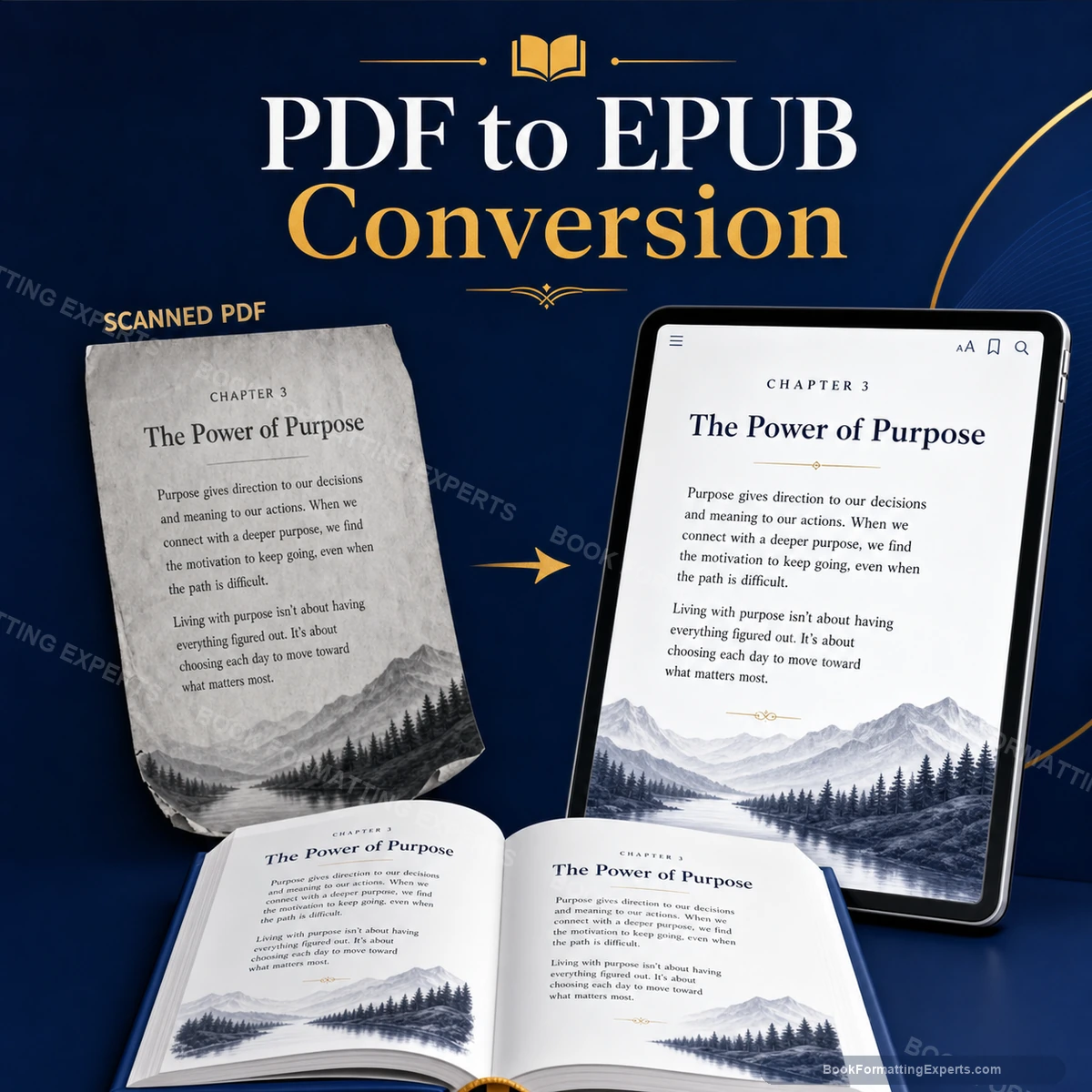
Scanned PDF Rebuild
A finished Scanned PDF Rebuild example from our PDF to EPUB Conversion work.
Image Rich PDF
A finished Image Rich PDF example from our PDF to EPUB Conversion work.
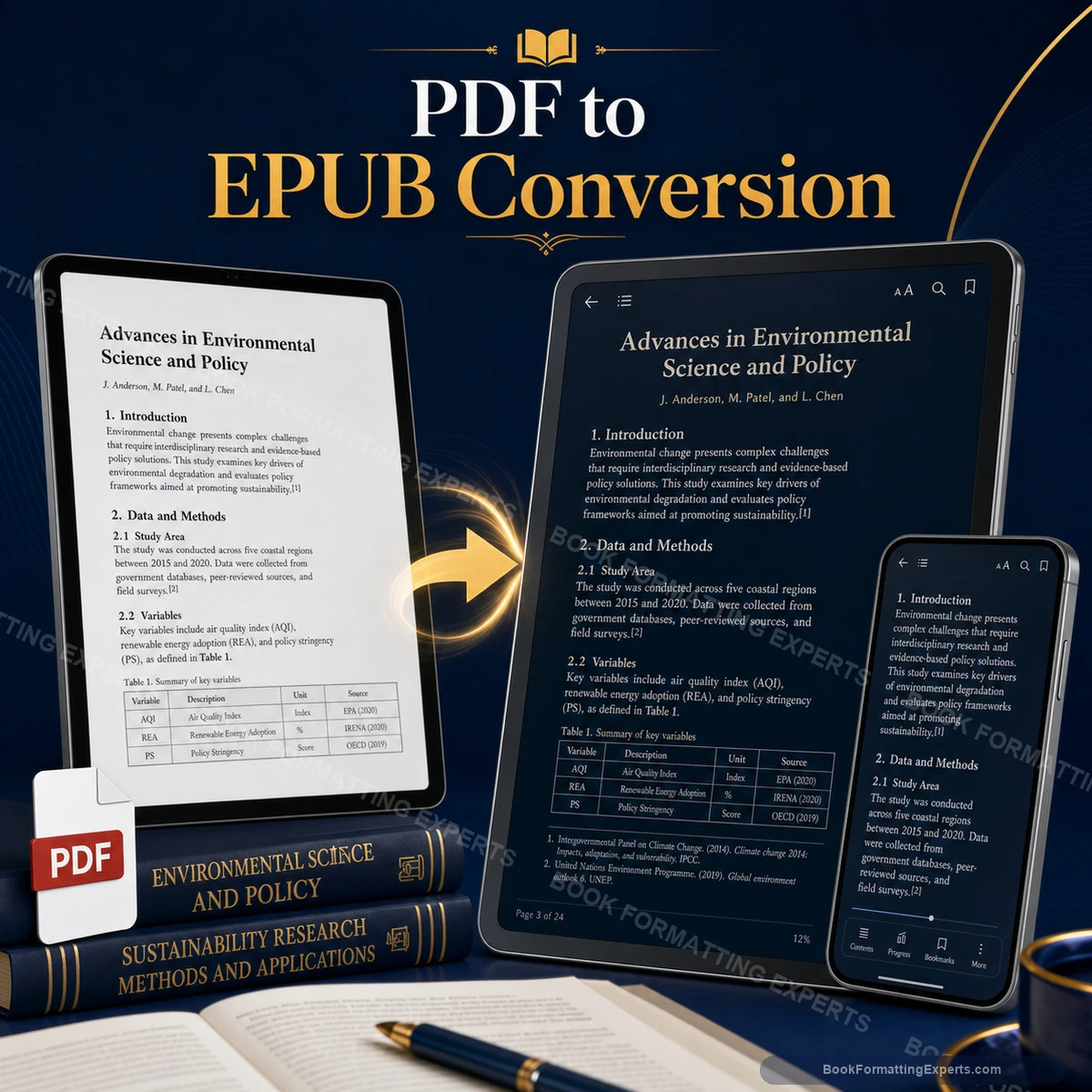
Academic PDF
A finished Academic PDF example from our PDF to EPUB Conversion work.
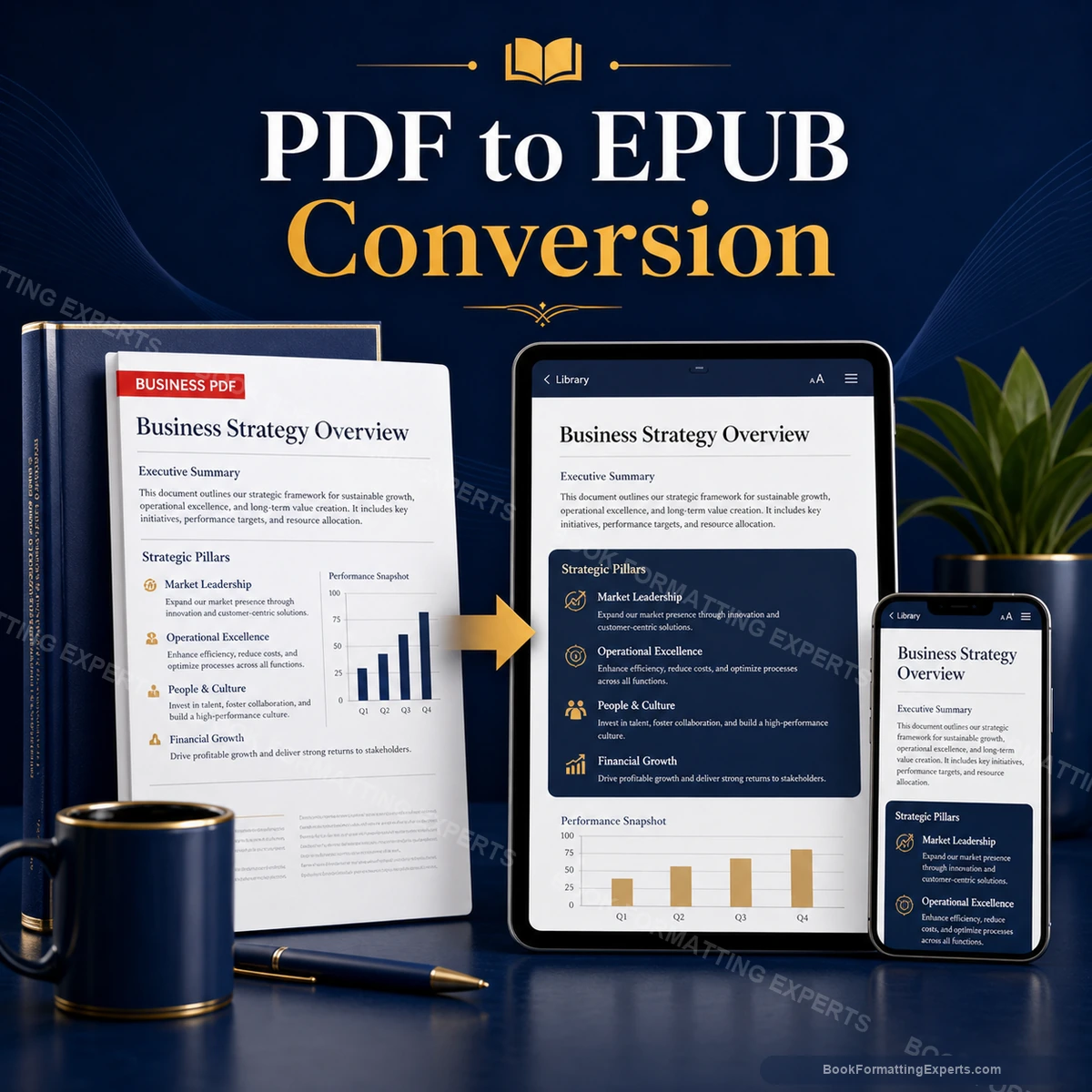
Business PDF
A finished Business PDF example from our PDF to EPUB Conversion work.
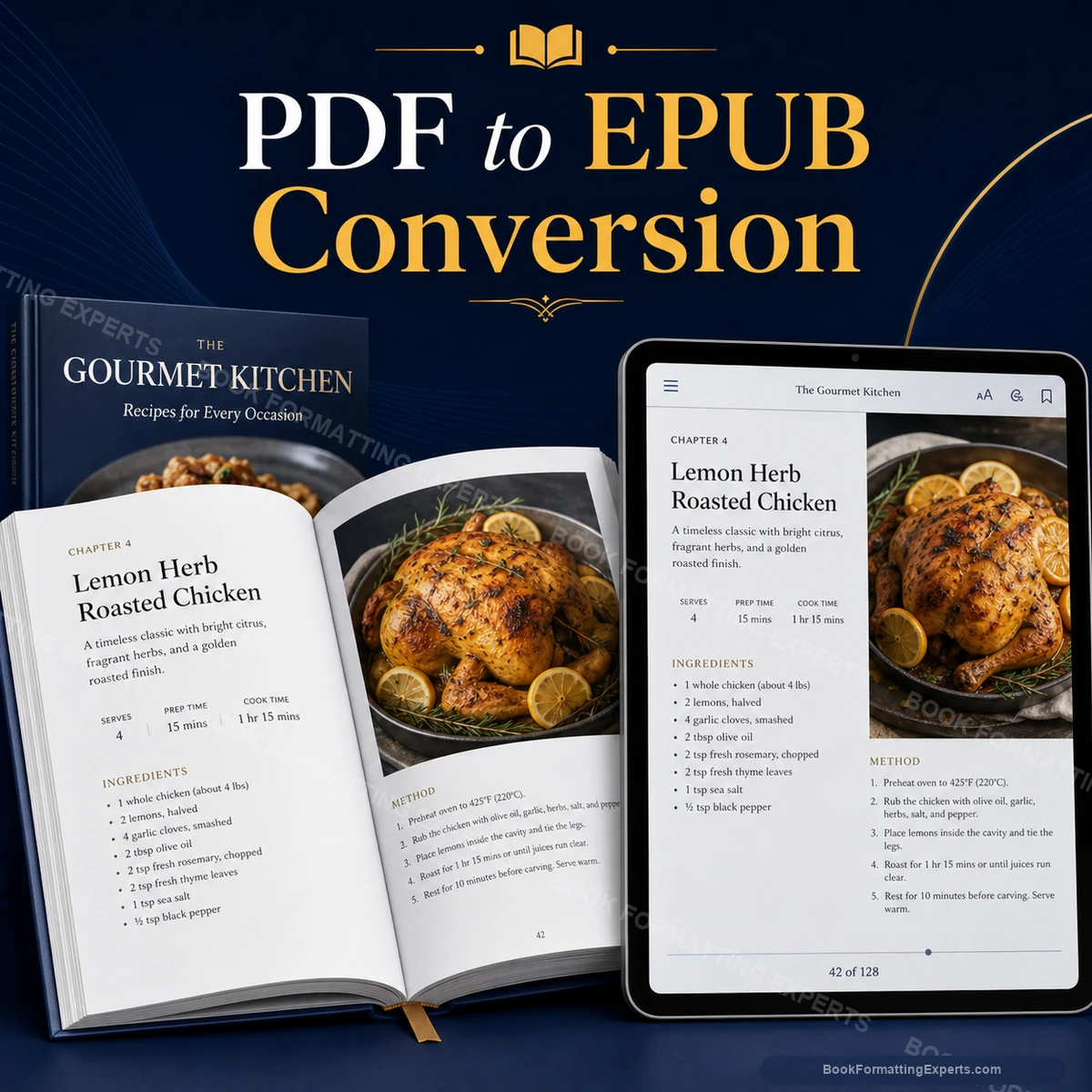
Cookbook PDF
A finished Cookbook PDF example from our PDF to EPUB Conversion work.
Our standard
The standard we hold every PDF-to-EPUB conversion to
Fix causes, not symptoms
Our PDF to EPUB conversion work corrects the underlying structure, so the same problem does not return when the text changes. It is a standard we hold on every PDF to EPUB conversion job, whatever the price of the package or the length of the book.
Evidence over assurance
For a PDF-to-EPUB conversion, we supply the validation or preflight report with your files, so a clean result is something you can see. With your PDF-to-EPUB conversion, you can check it for yourself, because the evidence comes with your files. Holding to it costs us time, and it saves you the cost of repairs later on this PDF-to-EPUB conversion project.
Plain communication
On this PDF-to-EPUB conversion job, we explain what we found and what we did in plain language, and we tell you honestly when something is outside what the file can support. Holding to it costs us time, and it saves you the cost of repairs later on this PDF-to-EPUB conversion project.
Checklist
The pre-delivery checklist for a PDF-to-EPUB conversion
Every item below is verified on your PDF-to-EPUB conversion before it leaves our desk.
- Audit completed and agreed with you
- Text extraction checked and corrected
- Structure rebuild checked and corrected
- Image recovery checked and corrected
- EPUB build and validation checked and corrected
- Validation or preflight run with the report supplied
- Previewer and device checks completed
- Text compared with the approved manuscript
- Specification and change log delivered
How we think
How we think about your PDF-to-EPUB conversion
Structure first
In PDF to EPUB conversion, text extraction and structure rebuild are built into the file, not painted on top. We treat structure as the foundation and appearance as the finish, because structure is what survives edits and platform changes for the PDF-to-EPUB conversion.
Checked, not hoped
For a PDF-to-EPUB conversion, a file is not finished because it looks right on our screen. It is finished when the validator, the preflight and real devices agree, and when we can show you the evidence with your PDF-to-EPUB conversion. It is the principle behind most of what we do on PDF to EPUB conversion, and the reason we prefer to explain our choices rather than hide them.
Your files stay yours
We deliver source files and a specification, and we never lock your PDF to EPUB conversion work inside a proprietary format. With your PDF-to-EPUB conversion, if you hire someone else later, they can pick up where we stopped.
Client reviews
What authors say about our PDF to EPUB conversions
Verified reviews from authors whose PDF files we converted.
My EPUB was rejected twice by Apple Books before I found Book Formatting Experts. They identified the metadata errors, rebuilt the file properly, and the new version passed immediately. Wish I had contacted them first.
The EPUB renders perfectly on my Kindle, Apple Books, and Kobo. The clickable table of contents works exactly as it should. Clean, standards-compliant, and ready to distribute everywhere.
Converting my nonfiction manuscript to EPUB while preserving the heading structure, footnotes, and internal links was no small task. Every element survived the conversion perfectly.
The interactive elements in my EPUB — internal links, chapter navigation, and resource appendix — all work perfectly. My readers have specifically mentioned how easy the ebook is to navigate.
My business EPUB had tables and callout boxes that needed to be handled carefully. Everything was converted cleanly without losing any structural information. The file passed Amazon's validator on the first check.
A fixed-layout EPUB for a cookbook is genuinely complex. The recipe layouts, ingredient lists, and photography all needed to remain pixel-perfect. The result looks as good as the print version on every device.
The reflowable EPUB looks perfect on every device I tested — Kindle, Apple Books, and Kobo. The clickable table of contents and chapter navigation work exactly as they should.
My fantasy EPUB had complex nested structures with chapter epigraphs and world-building inserts. The EPUB handles every level cleanly and reads beautifully on Kindle and Apple Books.
Academic EPUB with complex equations and references. One formula needed manual correction in revisions but the overall quality was exactly right. The file validates without errors on all platforms.
I had a previous EPUB that displayed incorrectly on several devices. Book Formatting Experts rebuilt it from scratch. The new version renders beautifully across every reader app I tested.
Good eBook formatting work. The tables converted cleanly and the navigation works well. One heading level needed a style adjustment but it was corrected quickly. The file performs well on all platforms.
My coaching workbook had exercises, worksheets, and reflection prompts alongside regular chapters. Every element was formatted to serve both digital completion and print. The result looks professional and functional.
My historical novel had period-appropriate chapter epigraphs and an author's note section. Every element was formatted with understanding of the genre's conventions. My literary agent commented on the professional quality.
My world-building sections, map pages, and chapter epigraphs were all handled with genuine understanding of the genre. The interior feels as immersive as the story itself. My readers noticed immediately.
Good formatting work on my early reader book. The large font and generous spacing were applied correctly. One illustration needed repositioning in revisions but it was fixed quickly. Happy with the result.
The interior layout of my self-help book supports how readers actually use the content. The journaling prompts, key insight boxes, and chapter summaries all flow naturally. Beautifully structured throughout.
Tight, clean, and exactly on brief. The chapter openers had the tension-driven feel the genre demands without being overdone. Upload to KDP was approved without a single correction requested.
Every recipe page has the right visual hierarchy — ingredients clearly separated from method, clear serving sizes, and consistent styling throughout. My readers can use the book comfortably in the kitchen.
FAQ
PDF to EPUB Conversion: questions answered
These are the questions authors ask most about PDF to EPUB conversion, including tools, scans and cost. If your question about the PDF-to-EPUB conversion is missing, request a quote and a specialist will reply.
Is there a free PDF to EPUB conversion?
Yes, but free tools often leave broken lines and no structure. For PDF to EPUB conversion, we check the result against the platform's own rules before you see it.
Can I do PDF to EPUB conversion online?
Yes, though results vary. On this PDF-to-EPUB conversion job, we keep a record of what we changed so that you can review the work.
What is a PDF to EPUB conversion tool?
It is software that converts a PDF into an EPUB file. On this PDF-to-EPUB conversion job, the calculator on this page shows the fixed price for each package before you commit.
How long does PDF to EPUB conversion take?
A clean text PDF takes a few days, and a scanned book takes longer. If you are unsure, send the file and we will tell you what the job involves on this PDF-to-EPUB conversion project.
What is the best PDF to EPUB conversion?
A rebuild from clean text gives the best result. Revision rounds are included, so the first delivery does not have to be perfect for the PDF-to-EPUB conversion.
What is Zamzar?
It is an online file converter that can convert PDF to EPUB, with limited quality control. For PDF to EPUB conversion, we check the result against the platform's own rules before you see it.
How does PDF to EPUB conversion work?
Text is extracted, structure is rebuilt and an EPUB is packaged. On this PDF-to-EPUB conversion job, we keep a record of what we changed so that you can review the work.
How do I convert a PDF to EPUB?
Extract and clean the text, rebuild structure and package an EPUB. On this PDF-to-EPUB conversion job, the calculator on this page shows the fixed price for each package before you commit.
Do you offer a PDF to EPUB conversion service?
Yes. If you are unsure, send the file and we will tell you what the job involves on this PDF-to-EPUB conversion project.
How much does it cost?
The calculator on this page shows a fixed price for each package for the PDF-to-EPUB conversion. Revision rounds are included, so the first delivery does not have to be perfect for the PDF-to-EPUB conversion.
Can you convert a scanned PDF?
Yes, with OCR and proofreading. For PDF to EPUB conversion, we check the result against the platform's own rules before you see it.
Do you need the source file?
It helps, but is not required. On this PDF-to-EPUB conversion job, we keep a record of what we changed so that you can review the work.
Is there a free PDF to EPUB converter?
Free tools exist, but they usually give messy output. We rebuild the structure properly. On this PDF-to-EPUB conversion job, the calculator on this page shows the fixed price for each package before you commit.
Can you convert a scanned PDF?
Yes, using OCR followed by a careful proofread. If you are unsure, send the file and we will tell you what the job involves on this PDF-to-EPUB conversion project.
Should I convert or start from the source?
If you have the source, we recommend it. We advise honestly. Revision rounds are included, so the first delivery does not have to be perfect for the PDF-to-EPUB conversion.
Can you convert a PDF book to reflowable EPUB?
Yes. We convert a PDF book to reflowable EPUB by extracting the text and rebuilding the structure.
Can you do PDF to EPUB for Kindle?
Yes. The EPUB that we build is accepted by KDP, and we test it in Kindle Previewer.
Can you convert a scanned PDF to EPUB?
Yes. We run OCR on the scan, proofread the output and build the EPUB.
Can you keep images and layout in a PDF to EPUB conversion?
Images are extracted and placed. Layout is rebuilt as reflowable, or as fixed layout when the design depends on it.
What does PDF to ebook conversion cost?
PDF to ebook conversion cost depends on whether the PDF has live text or is scanned, and the calculator shows a fixed price.
Is PDF to EPUB right for self-published books?
Yes. PDF to EPUB for self-published books is a common route when the source file has been lost.
How much does PDF to EPUB conversion cost?
Pdf to ebook conversion cost starts at $199 for a short book and rises to $789 for the longest length priced online. Pdf to epub with images and layout adds a small amount, and the calculator shows the exact total.
How long does PDF to EPUB conversion take?
Most PDFs are converted in five to seven working days, depending on length, images and whether the book is scanned. Priority and Express options shorten the schedule for your PDF-to-EPUB conversion, and the calculator shows an estimate before you pay. Our pdf to epub conversion service stays fast because every file is assessed on day one.
What are the baked hyphens everyone warns about in PDF conversions?
When a printed book was typeset, words were broken across line endings with hyphens. In a PDF those hyphens are real characters sitting in the text, exactly as real as the letters around them. Extract the text and the hyphens come too. Reflow it to a phone screen and the line endings move, but the hyphens do not, so words are split in places they never broke. It is the clearest possible signature of a conversion nobody checked, and readers spot it within a page.
How accurate is OCR, and do you check it?
On clean modern print, recognition is usually above 98 percent accurate, which sounds excellent until you work out that it means several hundred wrong characters in a novel. Worse, it does not report doubt. It substitutes a character it is confident about and continues, so the errors are fluent and plausible rather than obviously broken. Every recognised page we produce is proofed against its scanned image by a person. On a scanned title that proofing is the largest single cost in the job, and it is not optional.
What if my PDF has poetry, verse or unusual line breaks?
Then it is the most fragile thing on this page and it needs saying up front, because recovering it carelessly is destructive. Poetry survives in a PDF by accident, since the fixed page happened to preserve the line breaks the poet intended. Extract it and every poem becomes a paragraph, or worse, a paragraph with hyphens in it. We rebuild verse as real line-level markup, with hanging indents for runover lines that hold at any type size, and we do it line by line.
Ready when you are
Ready to start your PDF-to-EPUB conversion?
A finished PDF should not stay locked in a fixed page. Get your conversion price in a minute, or send a larger project and we will quote it.
- Fixed price shown before you pay
- Revision rounds included
- One named specialist, brief to upload