An accessible ebook is one that every reader can use, including readers who are blind or have low vision, readers with dyslexia, readers who cannot use a touch screen and readers who rely on text-to-speech. Accessibility is no longer a nicety. The European Accessibility Act, which applies from June 2025, requires many ebooks sold in the European Union to be accessible. Publishers, libraries, schools and universities increasingly require accessible files. And accessible books are better for everyone: they are better structured, easier to navigate and easier to adapt. Accessible EPUB formatting builds these qualities in.
Accessible EPUB Formatting · from $199
Accessible EPUB formatting that every reader can use and every retailer accepts
Accessible EPUB formatting builds an ebook that readers with visual, motor or cognitive disabilities can use with assistive technology, and it is increasingly a legal and commercial requirement for publishers. Our accessible epub formatting service applies the EPUB Accessibility standard and WCAG principles, adds alternative text and metadata, and verifies the result with checkers and a manual review. Choose a word count and the fixed price of an accessible build appears at once.
View Pricing
Most books are delivered within five to seven working days.
- EPUB Accessibility and WCAG aligned
- Alt text and metadata included
- Fixed price and clear turnaround
Key facts
- $199Starting price for the accessible EPUB, before extras
- 2 roundsOf revisions included in every accessible EPUB order
- 2 to 3 daysFastest standard delivery for a short accessible EPUB
Overview
What an accessible EPUB actually involves
The standard to meet is EPUB Accessibility 1.1, which in turn relies on the Web Content Accessibility Guidelines, WCAG, at level AA. The practical requirements are clear. The text must be real text, not images. The heading structure must be logical. Every meaningful image needs a text alternative. Navigation must work from the keyboard and with a screen reader. Language must be declared. Reading order must be correct. Tables must be marked up properly. Colours must have enough contrast, and meaning must not rely on colour alone. And the package metadata must declare the accessibility features, hazards and summary, so that stores and readers know what the book offers.
Our accessible EPUB formatting service builds or repairs a file to this standard. We structure the content, write alt text with you, mark up tables and lists, set language and reading order, add the accessibility metadata and run Ace by DAISY and EPUBCheck. We test with a screen reader and with text-to-speech. We deliver a validated file and a conformance report, which publishers can use to answer procurement questions. If you need a statement for the European Accessibility Act, we can help with the supporting documentation.
We start every accessible EPUB formatting job with an audit. On this accessible EPUB job, we open your file or manuscript, list what is already right, what is wrong and what needs a decision from you, and send that back before any work begins. The audit is why there are no surprises: you know the scope, the price and the schedule, and you know which of reading order and structure and alt text and images is likely to need the most care.
An accessible EPUB with alt text describes each meaningful image in words, marks decorative images so screen readers skip them and includes accessibility metadata. We write alt text that helps a reader follow the book.
Why it matters
Why an accessible EPUB matters
Accessible EPUB formatting shapes the reading experience
Readers with low vision or dyslexia rely on structure and flexible text. Readers rarely name the cause, but they feel the difference between careful and careless accessible EPUB formatting work. The effect is cumulative: each small decision in accessible EPUB formatting supports the next, so the book gains authority page by page.
The details carry the quality
Libraries, schools and some retailers ask for accessibility metadata. Each detail in accessible EPUB formatting has a tolerance, and a professional knows where it lies and how to check it. None of this is visible when it is done well, which is exactly why careful accessible EPUB formatting work is easy to undervalue.
Doing it once, properly, saves time
Regulations such as the European Accessibility Act affect publishers selling in Europe. Getting accessible EPUB formatting right at the start also keeps later edits, reprints and new editions inexpensive. It is far easier to get accessible EPUB formatting right while the book is still a working file than to repair it after publication.
Accessibility built into the structure
EPUB accessibility standards
An accessible file is built, not repaired at the end. We use semantic headings, a logical reading order, language tags, a complete navigation document and alternative text for images, and we describe those features in the metadata so that stores and readers can see what the book offers.
The epub accessibility standards that apply are the EPUB Accessibility specification, which refers to WCAG for content, and the schema.org accessibility properties for metadata. We follow both, and we provide wcag epub formatting that covers contrast, text resizing, link text and the structure of tables and lists.
For publishers asking about european accessibility act epub compliance, we deliver files with the structure and metadata that the Act's technical requirements call for, along with a summary you can keep in your records. We cannot give legal advice, and we make sure the file meets the technical standards that the Act relies on.
- Semantic structure and a logical reading order
- Alternative text for every meaningful image
- Accessibility metadata that stores can display
Choose the right build
The first decision in any accessible EPUB
Accessible reflowable EPUB
A text-led ebook meeting the standard. We choose this route when the book leans on reading order and structure, and we show a sample before the whole accessible EPUB formatting job proceeds. We show a sample of each route where it helps, so you can choose from evidence rather than from a description for the accessible EPUB.
Accessible fixed-layout EPUB
A picture book with text and descriptions. We choose this route when alt text and images are central to how the book is used, and we explain the cost and schedule consequences before you commit.
Specification
The accessible EPUB specification we build to
These are the decisions we make on every accessible EPUB job, and the reason for each one.
Element
How we build it
Why it matters
Structure
Logical headings and reading order. We confirm the value with you before building, and record it in the specification for your accessible EPUB formatting job.
Screen readers follow it. Getting this right early avoids rework once the accessible EPUB formatting pages have been proofed.
Alt text
Meaningful descriptions. We apply it through a defined style or setting, so it holds across the whole accessible EPUB formatting file.
Images are accessible. Readers and reviewers notice when it is wrong, even when they cannot say what is wrong with your accessible EPUB.
Metadata
Accessibility properties declared. We verify it again in the final proof, because it is easy to disturb during late edits for the accessible EPUB.
Buyers can filter. With your accessible EPUB, platforms and printers check it automatically, and a failure delays the launch.
Tables
Header cells marked. Where your platform sets a different rule, we follow the platform and tell you why with your accessible EPUB.
Data makes sense aloud. It also keeps later editions of the accessible EPUB formatting work consistent with the first.
Files
An accessible EPUB, an accessibility report and an alt text list, named consistently and delivered with a short specification.
A clear package prevents mix-ups between versions and speeds up any later change for the accessible EPUB. Getting this right early avoids rework once the accessible EPUB formatting pages have been proofed.
Checks
Preflight or validation run on every deliverable, with the report supplied with your accessible EPUB. We apply it through a defined style or setting, so it holds across the whole accessible EPUB formatting file.
Evidence of a clean pass is what separates a checked file from a hopeful one for the accessible EPUB. Readers and reviewers notice when it is wrong, even when they cannot say what is wrong with your accessible EPUB.
See what it costs
See the price of your accessible EPUB in a minute
Choose a word count to see what an accessible EPUB costs for your own book, with the delivery estimate and any extras shown before you commit.
Build my priceProcess
How an accessible EPUB project runs
Send
You send the files and tell us what you need from the accessible EPUB formatting job, including where you plan to publish and any deadline. We confirm the scope and the price in this accessible EPUB order. You are never left guessing what comes next, because we confirm each stage of the accessible EPUB formatting job in writing.
Day 1
Audit
We examine the file, list what is correct and what must change, and send a short note with any decisions we need from you in this accessible EPUB order. If something unexpected turns up at this stage, we tell you at once and agree the fix before continuing in this accessible EPUB order.
Days 1 to 2
Plan
We agree the specification, including how we will treat reading order and structure and alt text and images, and confirm the schedule. This stage is where most questions arise, so we leave time for them in the schedule in this accessible EPUB order.
Day 2
Build
We carry out the work, applying defined styles and settings, and fixing faults at their source rather than covering them in this accessible EPUB order. You are never left guessing what comes next, because we confirm each stage of the accessible EPUB formatting job in writing.
Days 3 to 7
Check
For a accessible EPUB, we validate, preview and review the result against the specification, and compare the text with your manuscript. If something unexpected turns up at this stage, we tell you at once and agree the fix before continuing in this accessible EPUB order.
Days 8 to 9
Deliver
You receive the files, the specification and the change log, with support if a platform queries the file with your accessible EPUB. This stage is where most questions arise, so we leave time for them in the schedule in this accessible EPUB order.
Day 10
Before and after
An EPUB before and after accessibility work
The same page as a standard file and as an accessible one. The look is the same, and the experience for a screen-reader user is very different.
123Before
- 1Images with no description
- 2Headings styled visually and not marked as headings
- 3No accessibility metadata in the package
123After
- 1Images with useful alternative text
- 2Real headings that screen readers can navigate
- 3Metadata that lists the accessibility features
- 3problems found in the first review
- 3fixes checked in the final review
- 1named specialist owning every fix
- Fixedprice confirmed in the calculator before you order
A book more people can read
Readers who use assistive technology can enjoy it fully.
A file that meets requirements
Publishers selling in regulated markets have the structure they need.
Better discovery
Metadata helps stores and libraries to show accessible titles.
Pricing calculator
Build your accessible EPUB price
An accessible EPUB can be read by everyone, including readers who use screen readers, braille displays or high-contrast settings, and it increasingly decides whether libraries and institutions will buy the book. Choose your files and see the fixed price.
Beyond our online limit? Let us quote it properly.
An accessible EPUB above 150,000 words, or with more than 150 images, is quoted individually so nothing is missed. Send us the accessible EPUB details and a specialist replies with a fixed price and delivery date.
The price covers rebuilding, describing and verifying the EPUB. Specialist maths or musical notation description beyond normal limits, cover design and retailer fees are not included.
Price guide
Accessible EPUB Formatting cost at a glance
The table lists the accessible epub cost by length, with the base price, delivery time and the kind of book that fits each tier. The calculator adds extras to your accessible EPUB for an exact total.
Word count
Base price
Standard delivery
Typical book
Very short text
$199
2-3 working days
Very short text
Short text
$249
3-4 working days
Short text
Compact text
$309
3-5 working days
Compact text
Short book
$389
4-6 working days
Short book
Standard length
$479
5-7 working days
Standard length
Full-length text
$559
5-8 working days
Full-length text
Long text
$639
6-9 working days
Long text
Large text
$729
7-10 working days
Large text
Longest online length
$809
8-11 working days
Longest online length
More than 150,000 words
Custom quote
Agreed with your quote
Quoted individually
Comparison
Accessible EPUB Formatting compared with the alternatives
What you compare
A quick accessible EPUB formatting fix
Professional accessible EPUB formatting
Approach
A quick fix treats symptoms and leaves the cause in the file in this accessible EPUB order. That approach saves effort at the start and tends to cost more in repairs once the accessible EPUB formatting job is live.
A professional accessible EPUB formatting job finds and corrects the cause. We do this as standard on every accessible EPUB formatting job, and the evidence comes with your files.
Consistency
For a accessible EPUB, manual changes vary from page to page. For a accessible EPUB, it leaves the cause in place, so the same fault tends to return when the text changes.
Defined styles apply identically everywhere. On this accessible EPUB job, it is built to be repeated, so later editions cost less and match the first.
Validation
Success is judged by eye on one screen with your accessible EPUB. For a accessible EPUB, it is hard to check, so faults are usually found by readers instead of by the author.
Success is judged by the platform's own checks and real devices with your accessible EPUB. For your accessible EPUB, it is checked by a person and by software before it reaches you, so problems are found early.
Documentation
Nothing is recorded, so the next edition starts again for the accessible EPUB. That approach saves effort at the start and tends to cost more in repairs once the accessible EPUB formatting job is live.
On this accessible EPUB job, a specification and change log are supplied. We do this as standard on every accessible EPUB formatting job, and the evidence comes with your files.
Risk
A rejected upload costs days and may delay a launch for the accessible EPUB. For a accessible EPUB, it leaves the cause in place, so the same fault tends to return when the text changes.
For your accessible EPUB, files are tested before they reach you, and fixes are covered by the guarantee.
Cost
For your accessible EPUB, cheap at first, then repeated whenever something changes. For a accessible EPUB, it is hard to check, so faults are usually found by readers instead of by the author.
For a accessible EPUB, a fixed price and a reusable result. For your accessible EPUB, it is checked by a person and by software before it reaches you, so problems are found early.
Portfolio
Accessible EPUB portfolio
Finished examples of Accessible EPUB Formatting work from our portfolio, each one built for a real book.
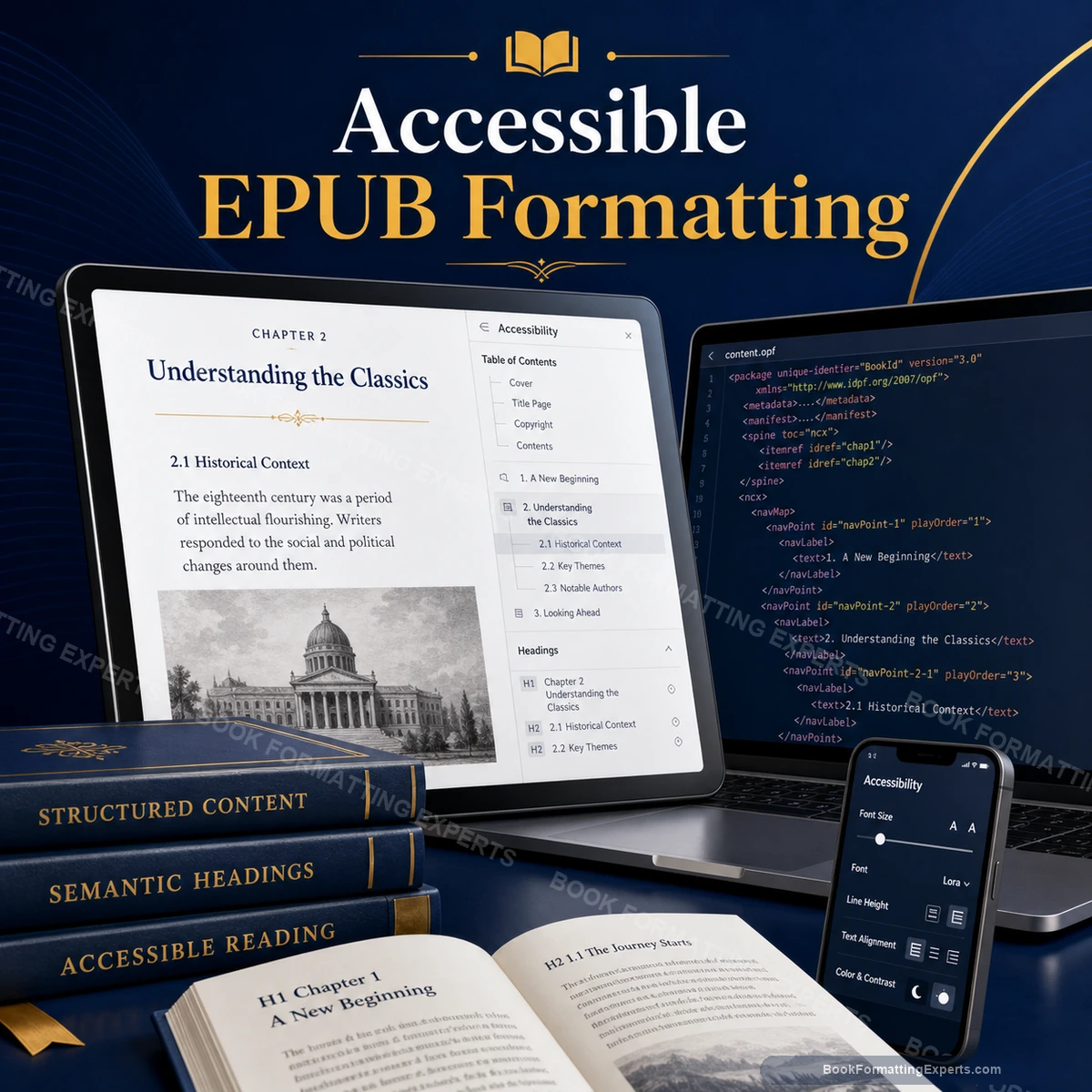
Semantic Heading Structure
A finished Semantic Heading Structure example from our Accessible EPUB Formatting work.
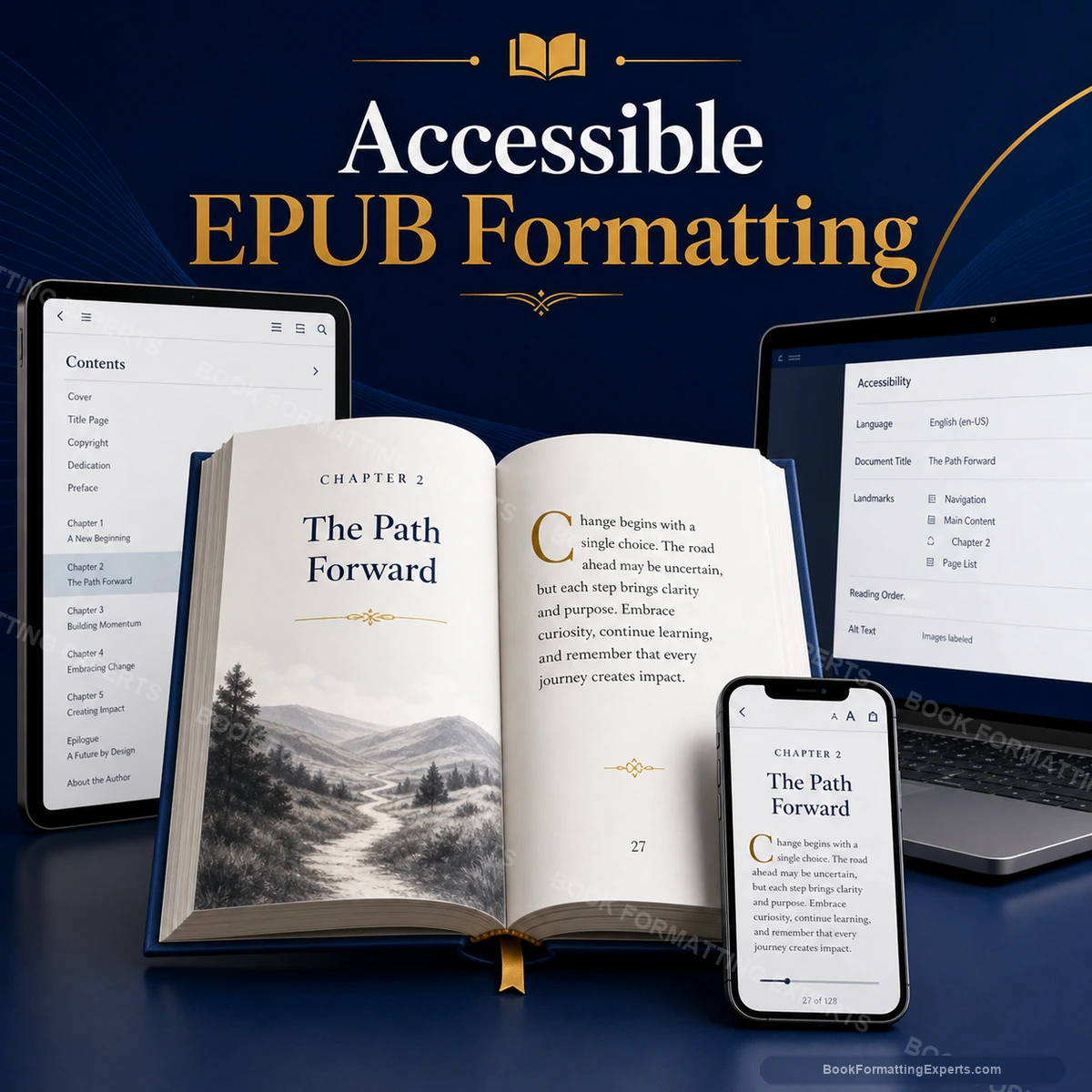
Image Alt Text
A finished Image Alt Text example from our Accessible EPUB Formatting work.
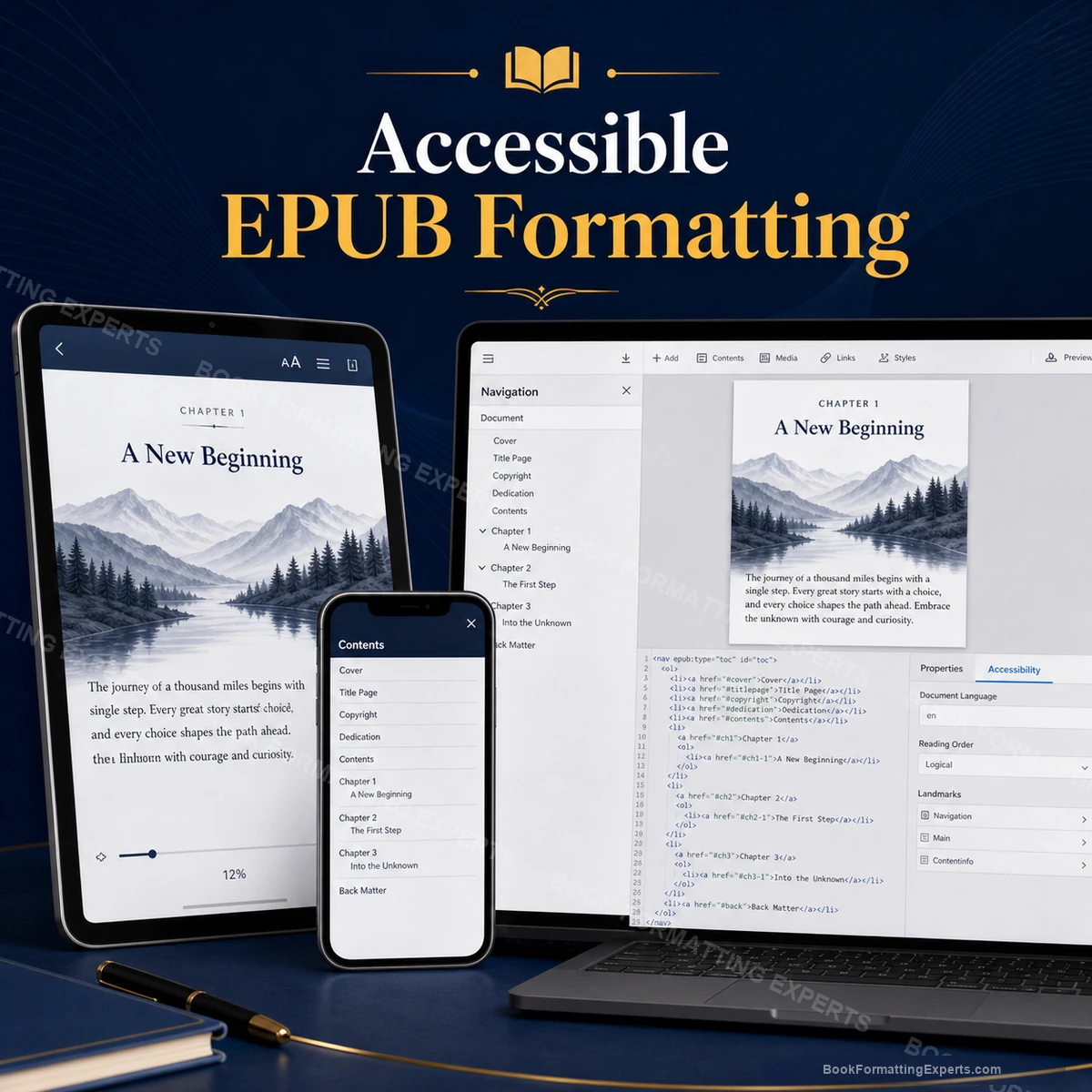
Logical Reading Order
A finished Logical Reading Order example from our Accessible EPUB Formatting work.
Scalable Readable Text
A finished Scalable Readable Text example from our Accessible EPUB Formatting work.
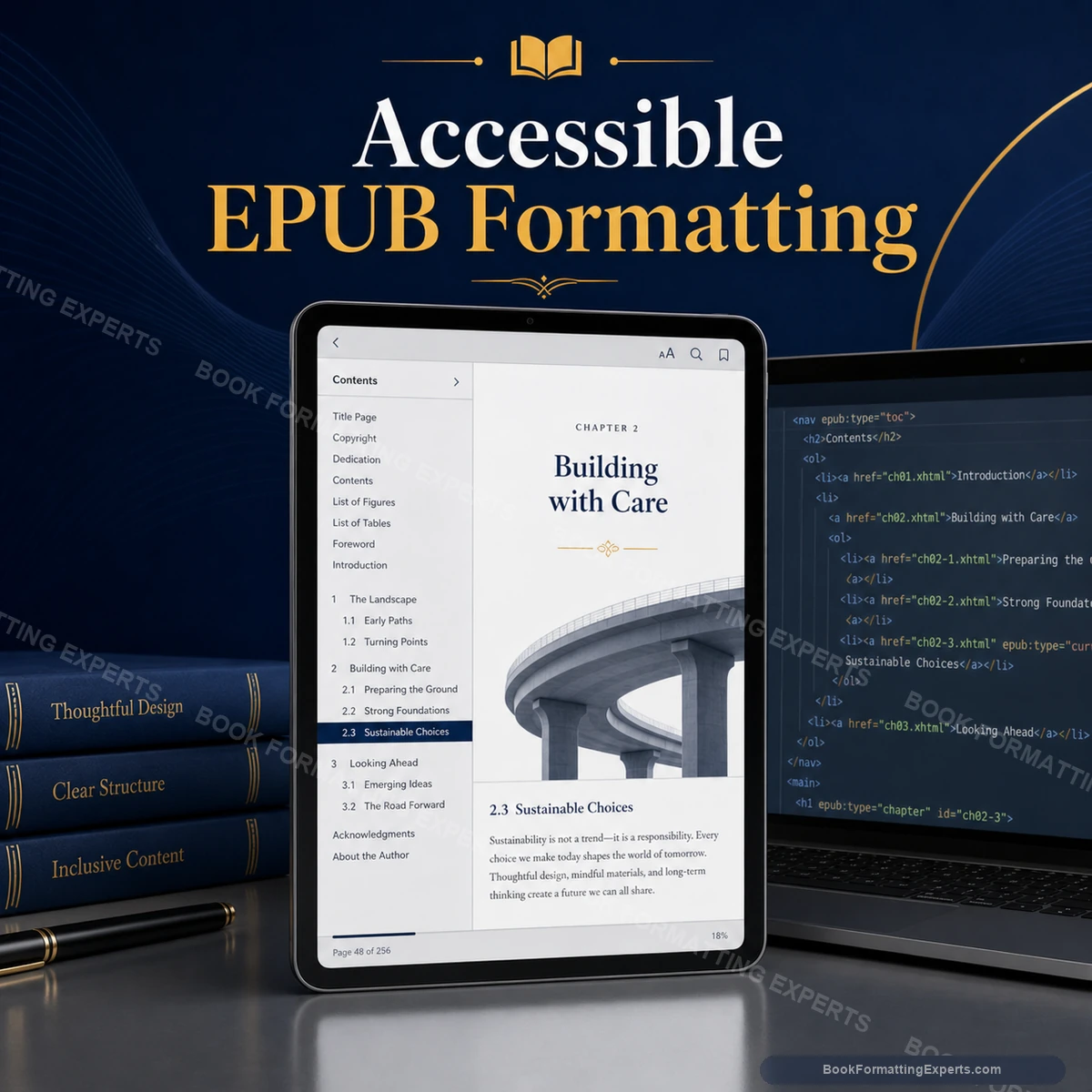
Accessible Navigation
A finished Accessible Navigation example from our Accessible EPUB Formatting work.
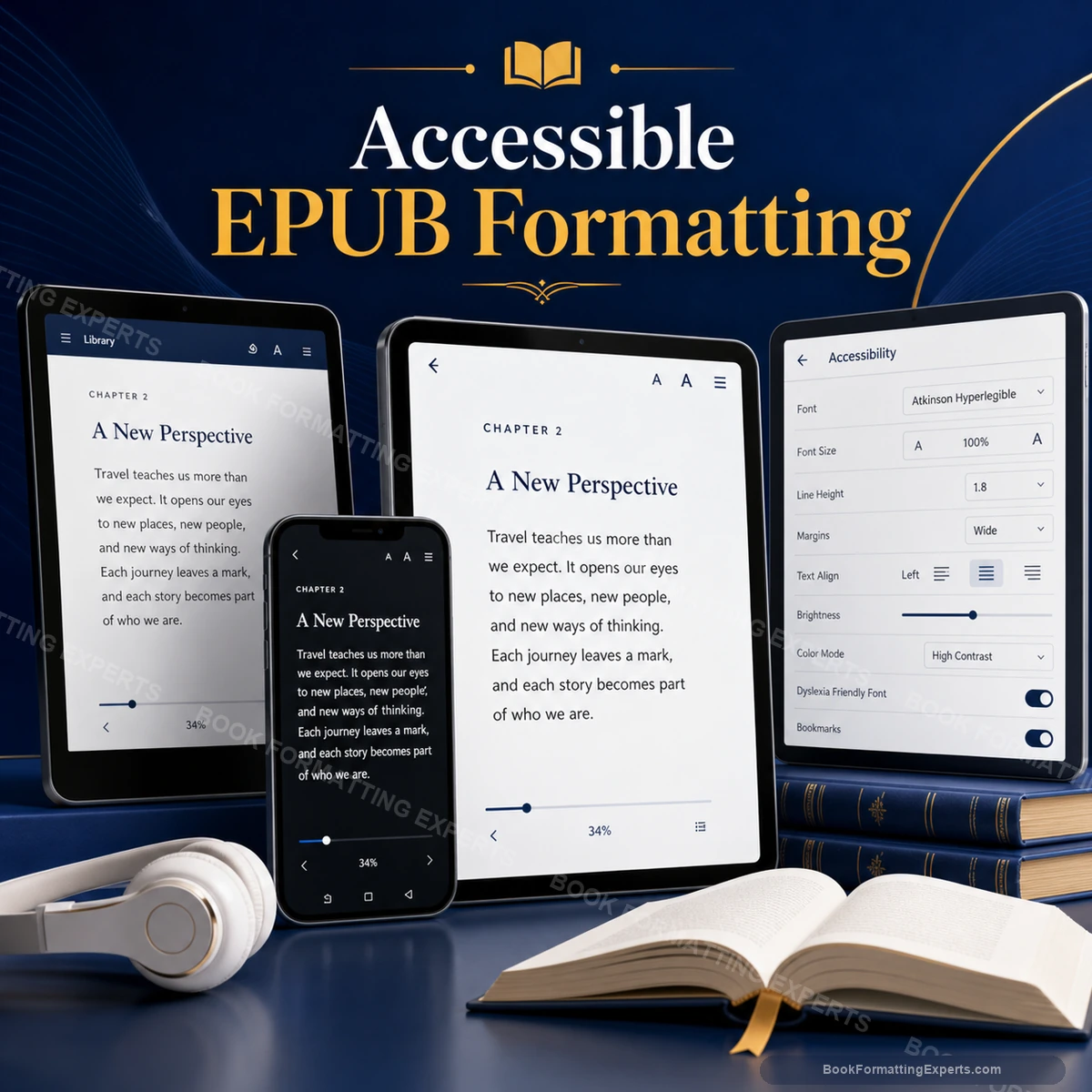
High Contrast Reading
A finished High Contrast Reading example from our Accessible EPUB Formatting work.
Our standard
The standard we hold every accessible EPUB to
Fix causes, not symptoms
Our accessible EPUB formatting work corrects the underlying structure, so the same problem does not return when the text changes. It is a standard we hold on every accessible EPUB formatting job, whatever the price of the package or the length of the book.
Evidence over assurance
For your accessible EPUB, we supply the validation or preflight report with your files, so a clean result is something you can see. You can check it for yourself, because the evidence comes with your files on this accessible EPUB project. Holding to it costs us time, and it saves you the cost of repairs later with your accessible EPUB.
Plain communication
For your accessible EPUB, we explain what we found and what we did in plain language, and we tell you honestly when something is outside what the file can support. Holding to it costs us time, and it saves you the cost of repairs later with your accessible EPUB.
Checklist
The pre-delivery checklist for an accessible EPUB
Every item below is verified on your accessible EPUB before it leaves our desk.
- Audit completed and agreed with you
- Reading order and structure checked and corrected
- Alt text and images checked and corrected
- Language and metadata checked and corrected
- Navigation and tables checked and corrected
- Validation or preflight run with the report supplied
- Previewer and device checks completed
- Text compared with the approved manuscript
- Specification and change log delivered
How we think
How we think about your accessible EPUB
Structure first
In accessible EPUB formatting, reading order and structure and alt text and images are built into the file, not painted on top. We treat structure as the foundation and appearance as the finish, because structure is what survives edits and platform changes on this accessible EPUB project.
Checked, not hoped
For your accessible EPUB, a file is not finished because it looks right on our screen. It is finished when the validator, the preflight and real devices agree, and when we can show you the evidence for the accessible EPUB. It is the principle behind most of what we do on accessible EPUB formatting, and the reason we prefer to explain our choices rather than hide them.
Your files stay yours
We deliver source files and a specification, and we never lock your accessible EPUB formatting work inside a proprietary format. If you hire someone else later, they can pick up where we stopped on this accessible EPUB project. It is the principle behind most of what we do on accessible EPUB formatting, and the reason we prefer to explain our choices rather than hide them.
Client reviews
What authors say about our accessible EPUBs
Verified reviews from publishers and authors whose accessible files we built.
A fixed-layout EPUB for a cookbook is genuinely complex. The recipe layouts, ingredient lists, and photography all needed to remain pixel-perfect. The result looks as good as the print version on every device.
The reflowable EPUB looks perfect on every device I tested — Kindle, Apple Books, and Kobo. The clickable table of contents and chapter navigation work exactly as they should.
The EPUB renders perfectly on my Kindle, Apple Books, and Kobo. The clickable table of contents works exactly as it should. Clean, standards-compliant, and ready to distribute everywhere.
My fantasy EPUB had complex nested structures with chapter epigraphs and world-building inserts. The EPUB handles every level cleanly and reads beautifully on Kindle and Apple Books.
Converting my nonfiction manuscript to EPUB while preserving the heading structure, footnotes, and internal links was no small task. Every element survived the conversion perfectly.
Academic EPUB with complex equations and references. One formula needed manual correction in revisions but the overall quality was exactly right. The file validates without errors on all platforms.
The interactive elements in my EPUB — internal links, chapter navigation, and resource appendix — all work perfectly. My readers have specifically mentioned how easy the ebook is to navigate.
I had a previous EPUB that displayed incorrectly on several devices. Book Formatting Experts rebuilt it from scratch. The new version renders beautifully across every reader app I tested.
My business EPUB had tables and callout boxes that needed to be handled carefully. Everything was converted cleanly without losing any structural information. The file passed Amazon's validator on the first check.
Good eBook formatting work. The tables converted cleanly and the navigation works well. One heading level needed a style adjustment but it was corrected quickly. The file performs well on all platforms.
My EPUB was rejected twice by Apple Books before I found Book Formatting Experts. They identified the metadata errors, rebuilt the file properly, and the new version passed immediately. Wish I had contacted them first.
Very good understanding of academic formatting requirements. One heading level needed adjustment in revisions but the overall standard was exactly right for a scholarly publication. My publisher was satisfied.
Every genre convention was applied correctly. The chapter openers, the dedication page, and the acknowledgements all flowed naturally. Readers have complimented how comfortable the book feels to read.
My bilingual poetry collection had French and Wolof on facing pages. The layout handled both languages with the right visual balance. One alignment correction in revisions and it was exactly right.
My psychological thriller had unreliable narrator chapters that needed specific typographic signals to the reader. Every formatting choice reinforced the story. My beta readers said the book felt cinematic.
The interior layout of my self-help book supports how readers actually use the content. The journaling prompts, key insight boxes, and chapter summaries all flow naturally. Beautifully structured throughout.
Getting the layout right for a picture book is genuinely difficult. The page proportions, text placement, and illustration spaces were all handled with real skill. My publisher was impressed by the result.
My paranormal romance had an unusual chapter structure with alternating POVs. Every transition was formatted cleanly. The visual rhythm of the page keeps readers moving through the story naturally.
FAQ
Accessible EPUB Formatting: questions answered
These are the questions authors ask most about accessible EPUB formatting, including standards, law and cost. If your question about the accessible EPUB is missing, request a quote and a specialist will reply.
What is accessible EPUB formatting?
It is formatting an EPUB so that every reader can use it, including with screen readers. For accessible EPUB formatting, we check the result against the platform's own rules before you see it.
Do you offer accessible EPUB formatting services?
Yes. We keep a record of what we changed so that you can review the work for the accessible EPUB.
What are EPUB accessibility standards?
EPUB Accessibility 1.1, which relies on WCAG 2.1 AA. The calculator on this page shows the fixed price for each package before you commit with your accessible EPUB.
What is European Accessibility Act EPUB compliance?
It is meeting the accessibility requirements that apply to ebooks sold in the EU from June 2025. If you are unsure, send the file and we will tell you what the job involves with your accessible EPUB.
What is accessible ebook for publishers?
It is an ebook built so that every reader can use it, supplied to meet institutional and legal needs. Revision rounds are included, so the first delivery does not have to be perfect in this accessible EPUB order.
What is WCAG EPUB formatting?
It is applying WCAG principles to the structure and content of an EPUB. For accessible EPUB formatting, we check the result against the platform's own rules before you see it.
Do you write alt text?
We write or review alt text with you. We keep a record of what we changed so that you can review the work for the accessible EPUB.
What is EPUB accessibility metadata?
It is the declarations in the package that describe accessibility features, hazards and a summary. The calculator on this page shows the fixed price for each package before you commit with your accessible EPUB.
What is accessible EPUB conversion?
It is converting a book into an EPUB that meets accessibility standards. If you are unsure, send the file and we will tell you what the job involves with your accessible EPUB.
How much does accessible EPUB formatting cost?
For a accessible EPUB, the calculator on this page shows a fixed price for each package. Revision rounds are included, so the first delivery does not have to be perfect in this accessible EPUB order.
Can you test with a screen reader?
Yes. For accessible EPUB formatting, we check the result against the platform's own rules before you see it.
Do you give a conformance report?
Yes. We keep a record of what we changed so that you can review the work for the accessible EPUB.
What are EPUB accessibility standards?
They are published guidelines, including EPUB Accessibility, which build on WCAG. We build to them. The calculator on this page shows the fixed price for each package before you commit with your accessible EPUB.
Does the European Accessibility Act affect ebooks?
Yes, for ebooks sold in the EU from the date it applies. We can advise on what that means for your files. If you are unsure, send the file and we will tell you what the job involves with your accessible EPUB.
Do you test with a screen reader?
Yes. Revision rounds are included, so the first delivery does not have to be perfect in this accessible EPUB order.
How much does accessible EPUB formatting cost?
The accessible epub cost starts at $199 for a short book and rises to $809 for the longest length priced online. Accessible epub formatting cost depends on length and images, and the calculator adds extras for an exact total.
How long does accessible EPUB formatting take?
Most books are delivered in five to seven working days, because the build and the checks take extra care. Accessible epub formatting services can be expedited with Priority or Express options, and the calculator shows an estimate.
What is an accessibilitySummary, and can you write mine?
It is the human-readable paragraph that appears on retailer pages, describing in plain language what your book supports and what it does not. Yes, we write it, and we write it from the finished file rather than from a template. It is worth real care, because for some readers it is the deciding factor on whether to spend money on your book.
Can you certify that my book is legally compliant?
No, and neither can anyone else selling you formatting. We build to a published technical standard, we test against it, and we document precisely what we found. Legal compliance is a determination for a lawyer or a formal auditor, and a badge issued by a typesetting studio would carry no weight anywhere it mattered. We would rather say this plainly than sell you false comfort.
What is a decorative image, and why does marking it matter?
A decorative image carries no information: a chapter ornament, a rule, a flourish. If it is not explicitly marked as decorative, a screen reader announces it, and a reader with thirty chapter ornaments in a book hears the word image thirty times for no purpose. Marking it means the reader passes over it in silence, which is exactly what a sighted reader does.
What do you need from me to quote accurately?
The manuscript and an honest count of the images, tables and equations in it. Word count sets the base, but the description work is what actually drives the figure, so a novel with two maps and a textbook of the same length are very different jobs. Send the book and we will tell you which one you have.
Ready when you are
Ready to start your accessible EPUB?
An ebook that more people can read is a book that more people can buy. Price your accessible EPUB in a minute, or send a larger project and we will quote it.
- Fixed price shown before you pay
- Revision rounds included
- One named specialist, brief to upload