
Fiction readers read a lot, and they read for long stretches. They are the people most likely to notice a cramped margin, a harsh typeface or a chapter opener that does nothing, because they spend hours inside the page and the page either helps them or it does not. Fiction book formatting is the craft of making that page invisible, so that nothing stands between the reader and the story. It covers the trim size, the margins, the typeface, the way chapters open, how scenes are divided, the front and back matter and the files that go to Amazon, IngramSpark and the ebook stores.
Fiction book formatting · from $239
Fiction book formatting that lets the story shine
Fiction book formatting from Book Formatting Experts gives your novel an interior that suits its genre, with chapter openers, scene breaks and typography that quietly support the story. You receive a validated eBook and a print-ready paperback from one design, ready for KDP and IngramSpark. Choose your word count to see your price right now.
View Pricing
Most novels are ready in 6 to 9 working days.
- eBook and paperback from one design
- Scene breaks, chapter openers and ornaments
- 2 revision rounds included
Fiction formatting at a glance
- $239Starting price, eBook and paperback together
- 2 formatsBuilt from one design, included in every price
- 2 roundsOf changes after the proof, included with every novel
Overview
What a fiction book formatting actually involves
The decisions are partly conventional and partly personal. Convention says that a novel is set in a serif face of about 11 points with leading of around 14, with a first-line indent and no extra space between paragraphs, with chapters that begin on a right-hand page and scene breaks marked by a blank line or an ornament. It says that the best trim size for a novel is one of a handful: 5 by 8, 5.25 by 8 or 5.5 by 8.5 inches, with 5.5 by 8.5 the most common for trade paperbacks. Personal choice comes in the ornaments, the drop caps, the chapter numbering style and the detail of the front and back matter. A novel formatted with scene breaks and drop caps in a style that suits its genre has a look that readers recognise and trust.
Our fiction book formatting service delivers a print interior and an ebook, for KDP, IngramSpark and the other retailers, designed to fit your genre. You tell us about the book, we propose a design with sample pages, you approve it and we build the whole book. We handle novels of any length, standalone or in a series, and we can add a matching cover. The price is fixed, the calculator on this page shows it and revisions are included. Whether you want to know how to format a novel for Kindle, how to format a novel for paperback or just want it done, the process is the same.
Before we set a single page we read the manuscript structurally, not editorially. We list every heading level, every special element and every place where the text depends on something the page must carry, such as scene breaks and chapter openers. That audit tells us how many styles the novel needs, which of them will be hard on a small screen, and where a decision is needed from you. It is also the reason the price is fixed: we know what the job contains before we quote it.
Why it matters
Why a fiction book formatting matters
Novels are structurally demanding
A novel is not a stream of paragraphs. It carries scene breaks, chapter openers and drop caps and ornaments, and every one of them needs a style, a rule for how it breaks across pages and a version that survives on a phone. Without a system, those elements drift, and readers feel the inconsistency even when they cannot name it.
Readers judge the finish
Readers who want to disappear into a story read with a purpose and notice carelessness quickly: an uneven heading, a table that splits badly, a margin that swallows the text near the spine. A professional interior tells the reader that the content was handled with the same care as the book was written.
Platforms are strict
KDP, IngramSpark and the ebook retailers each reject files for specific faults, from missing bleed to broken navigation. Files built correctly the first time go live quickly, while files that fail cost days in re-uploads and can delay a launch or a course start date.
Novel formatting with scene breaks and drop caps
The small details readers feel
A novel's interior is felt rather than noticed: the rhythm of the paragraphs, the look of a chapter start, the pause of a scene break. These details tell the reader what kind of book this is before the first sentence lands.
We design the interior of your novel around its genre. A romance might call for a warm serif, a flourish at each scene break and a generous chapter opener. A thriller usually wants lean pages, short chapter openers and a brisk rhythm. Fantasy often benefits from ornamental chapter heads and room for a map, which is novel interior design with chapter ornaments working alongside scene breaks.
The point is the same everywhere: a consistent system that disappears on the page and quietly signals that this is a professionally published book.
- Scene breaks that survive page and screen breaks
- Chapter openers designed for your genre
- One design applied to eBook, paperback and any extras
Choose the right build
The first decision in any fiction book formatting
Quiet commercial novel formatting
Plain, unobtrusive pages with simple chapter openers. It suits most genre fiction. We use this approach when the book leans on scene breaks and a steady reading pace, and we prepare a sample spread so you can judge the feel before the whole novel is set.
Ornamented novel formatting
Drop caps, ornaments and decorative chapter heads. It suits romance, fantasy and gift editions for the fiction book formatting. We choose this route when chapter openers are central to how readers use the book, and we explain the cost and page-count consequences before you commit to it.
Specification
The fiction book formatting specification we build to
These are the decisions we make on every fiction book formatting job, and the reason for each one.
Element
How we build it
Why it matters
Trim size
5.5 x 8.5 inches unless the content demands otherwise, confirmed with a short test layout. We confirm the value with you before building, and record it in the specification for your novel job.
It is the most common trade size for novels, feels natural in the hand and prints economically at most page counts.
Body type
An 11-point serif such as Garamond or Caslon with comfortable leading, with leading chosen for a comfortable measure of roughly 60 to 70 characters.
Readers of a novel stay with the text longer when the page is comfortable to look at.
Margins
Inside margin increased with page count, outside and top margins balanced for the trim. With your fiction book formatting, we verify it again in the final proof, because it is easy to disturb during late edits.
A binding that swallows text is the most visible fault in a perfect-bound book. With your fiction book formatting, platforms and printers check it automatically, and a failure delays the launch.
Elements
Scene breaks, chapter openers, drop caps and ornaments and running heads and page numbers, each with a named style and break rules.
Consistency across the book is what makes it look professionally produced. It also keeps later editions of the novel work consistent with the first.
Print PDF
Fonts embedded, images at 300 pixels per inch, bleed added where required, transparency flattened if the printer asks.
The printer's preflight rejects files that break these rules. Getting this right early avoids rework once the novel pages have been proofed.
EPUB
Reflowable or fixed layout as the content requires, with a linked contents page and tested navigation.
Ebook retailers and reading systems each tolerate different markup, so structure must be clean. For a fiction book formatting, readers and reviewers notice when it is wrong, even when they cannot say what is wrong.
See what it costs
See what your novel will cost to format
See what your novel will cost to format in about a minute. Choose a word count, add any extras and the calculator returns a total and a delivery estimate with nothing hidden.
Build my priceProcess
How a fiction book formatting project runs
Send
You send the manuscript and tell us about the novel: its length, its special elements and where you plan to publish. We confirm what is included and what, if anything, needs a decision. You are never left guessing what comes next, because we confirm each stage of the novel job in writing.
Day 1
Specify
We audit the structure, choose the trim, type and styles and agree the specification with you, including how scene breaks and chapter openers will look. For your fiction book formatting, if something unexpected turns up at this stage, we tell you at once and agree the fix before continuing.
Days 1 to 2
Sample
We set sample pages that show the main elements, so you can approve the look before we invest time in the whole book. With your fiction book formatting, this stage is where most questions arise, so we leave time for them in the schedule.
Days 3 to 4
Format
We set the complete book to the approved specification, apply the styles, build the front and back matter and generate the contents. You are never left guessing what comes next, because we confirm each stage of the novel job in writing.
Days 5 to 10
Proof
You review the proof and send notes, and we correct and re-check until the layout is clean. Revision rounds are included in every package. For your fiction book formatting, if something unexpected turns up at this stage, we tell you at once and agree the fix before continuing.
Days 11 to 12
Deliver
You receive the final files, the specification and the settings sheet, with help available for upload. With your fiction book formatting, this stage is where most questions arise, so we leave time for them in the schedule. You are never left guessing what comes next, because we confirm each stage of the novel job in writing.
Day 13
Before and after
Fiction formatting before and after: a chapter that feels published
This is the same chapter before and after professional fiction book formatting. On the left, a flat chapter start, blank lines for scene breaks and default fonts. On the right, a designed opener, an ornamental scene break and typography chosen for the genre.
123Before
- 1A chapter start no different from the body
- 2Scene breaks made with empty lines
- 3Default fonts and uneven paragraphs
123After
- 1A designed opener with title and ornament
- 2Scene breaks marked with a clear flourish
- 3Type and spacing chosen for your genre
- 3problems found in the first review
- 3fixes checked in the final review
- 1named specialist owning every fix
- Fixedprice confirmed in the calculator before you order
Genre-aware design
Romance, thriller and fantasy each get the page they expect.
Details that read as craft
Openers, breaks and running heads that signal a professional book.
Easier to keep reading
Rhythm and spacing that keep the reader inside the story.
Pricing calculator
Build your fiction formatting price
A novel has to disappear into the reading, so the formatting should be invisible until the moment a chapter opener or a scene break earns a glance. Choose your editions and the structure of your story and see the fixed price for a fiction interior.
Beyond our online limit? Let us quote it properly.
A novel above 150,000 words, or with more than 150 images, is quoted individually so nothing is missed. Send us your fiction book formatting manuscript details and a specialist replies with a fixed price and delivery date.
The price covers formatting and proofing of your novel's interior. Cover design, ISBN purchase, editing and commissioned illustration are not included.
Price guide
Fiction book formatting cost by word count
Fiction book formatting cost follows word count, because length drives page count and testing time. The table shows base prices for eBook plus paperback across the nine bands, with delivery times and the kind of novel that fits.
Word count
Base price
Standard delivery
Typical book
Short story or collection
$239
3-4 working days
Short story or collection
Novelette
$309
4-5 working days
Novelette
Novella
$389
4-6 working days
Novella
Short novel
$469
5-7 working days
Short novel
Standard genre novel
$559
6-8 working days
Standard genre novel
Full-length genre novel
$639
6-9 working days
Full-length genre novel
Long genre novel
$729
7-10 working days
Long genre novel
Epic or fantasy saga
$809
8-11 working days
Epic or fantasy saga
Epic-length novel
$889
9-13 working days
Epic-length novel
More than 150,000 words
Custom quote
Agreed with your quote
Saga omnibus or complete series box set
Comparison
Fiction Book Formatting compared with the alternatives
What you compare
A DIY novel interior
A professionally formatted novel
Structure
A do-it-yourself novel often uses manual formatting, so headings and boxes look slightly different on every page.
Named styles make every heading, box and list identical and easy to revise. We do this as standard on every novel job, and the evidence comes with your files.
Margins
Margins are guessed or copied from a template, and the text can vanish into the gutter once the page count grows.
Margins are calculated from the final page count and paper. It is built to be repeated, so later editions cost less and match the first with your fiction book formatting.
Elements
Scene breaks and chapter openers are improvised, so they differ between chapters. It is hard to check, so faults are usually found by readers instead of by the author on this fiction book formatting project.
Each element has a style, a break rule and a tested ebook equivalent. It is checked by a person and by software before it reaches you, so problems are found early with your fiction book formatting.
Files
PDF export settings are left at defaults, and a printer's checker may reject the file.
Files are preflighted and delivered with the report. We do this as standard on every novel job, and the evidence comes with your files.
Ebook
A conversion from the print layout often produces broken navigation and awkward spacing. It leaves the cause in place, so the same fault tends to return when the text changes in this fiction book formatting order.
A separate, tested EPUB with real structure and a working contents page. It is built to be repeated, so later editions cost less and match the first with your fiction book formatting.
Result
The book looks like a draft, and readers notice. It is hard to check, so faults are usually found by readers instead of by the author on this fiction book formatting project.
The book looks like it came from a publisher, and the layout can be reused.
Portfolio
Fiction book formatting portfolio: novels in their own voice
Finished examples of Fiction Book Formatting work from our portfolio, each one built for a real book.
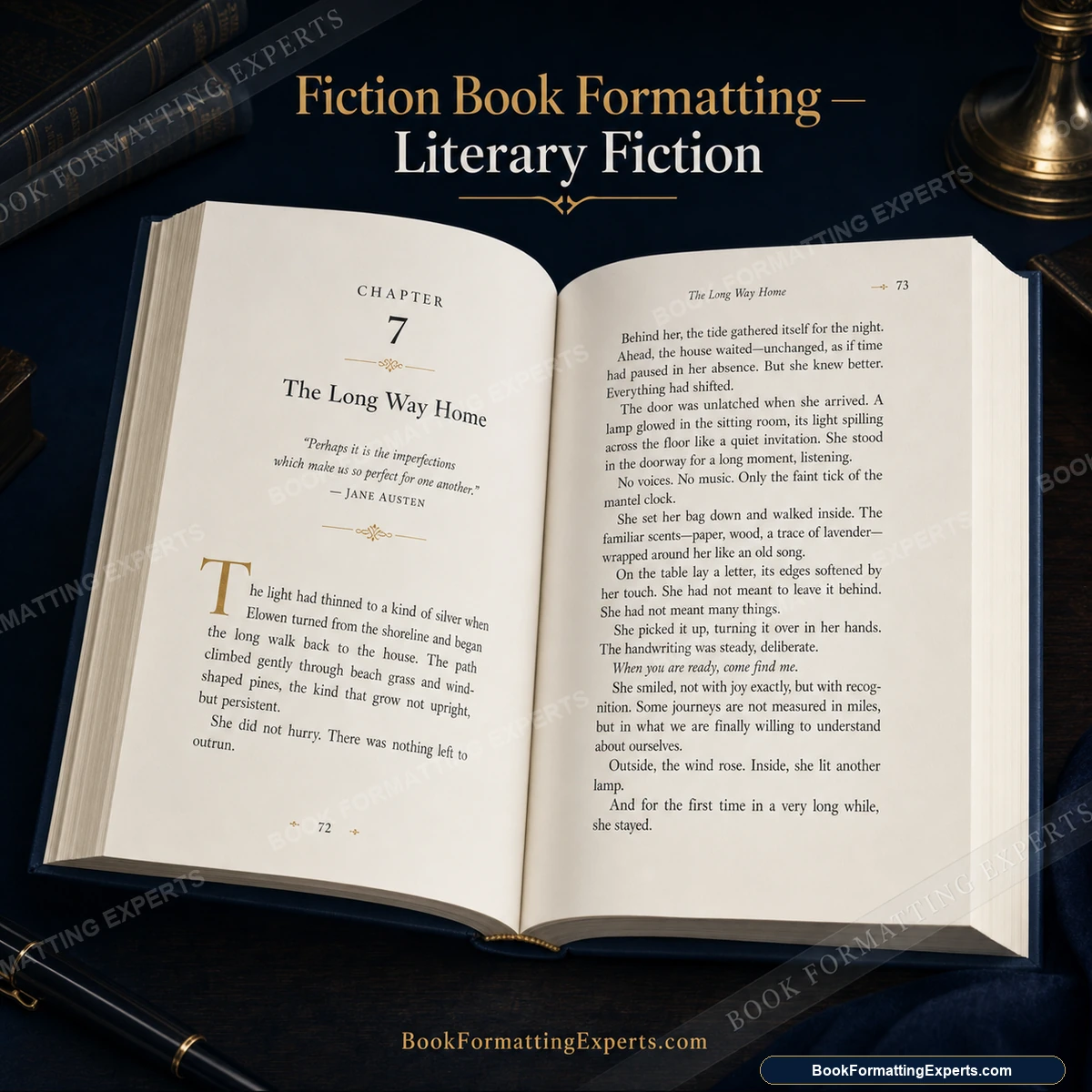
Literary Fiction
A finished Literary Fiction example from our Fiction Book Formatting work.
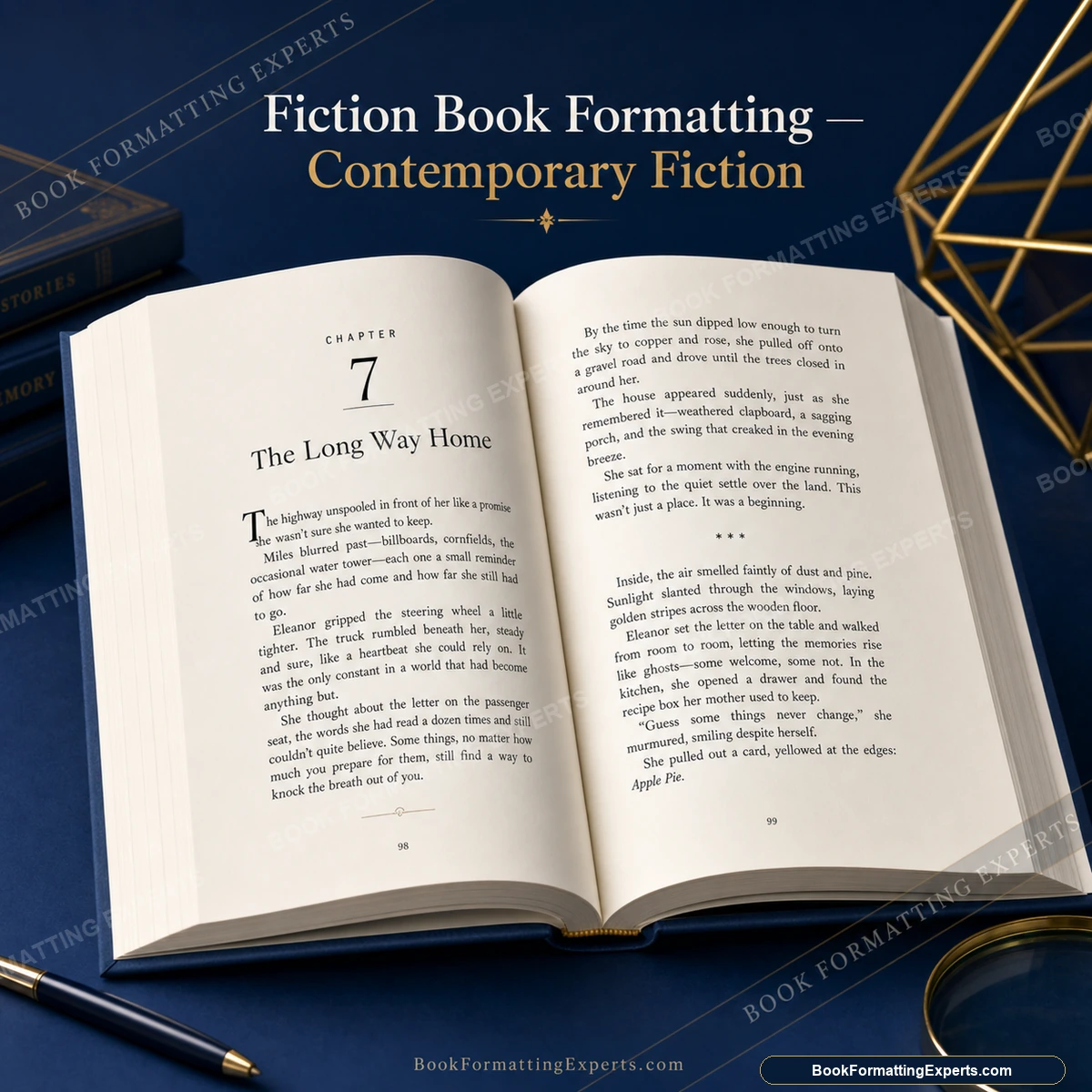
Contemporary Fiction
A finished Contemporary Fiction example from our Fiction Book Formatting work.
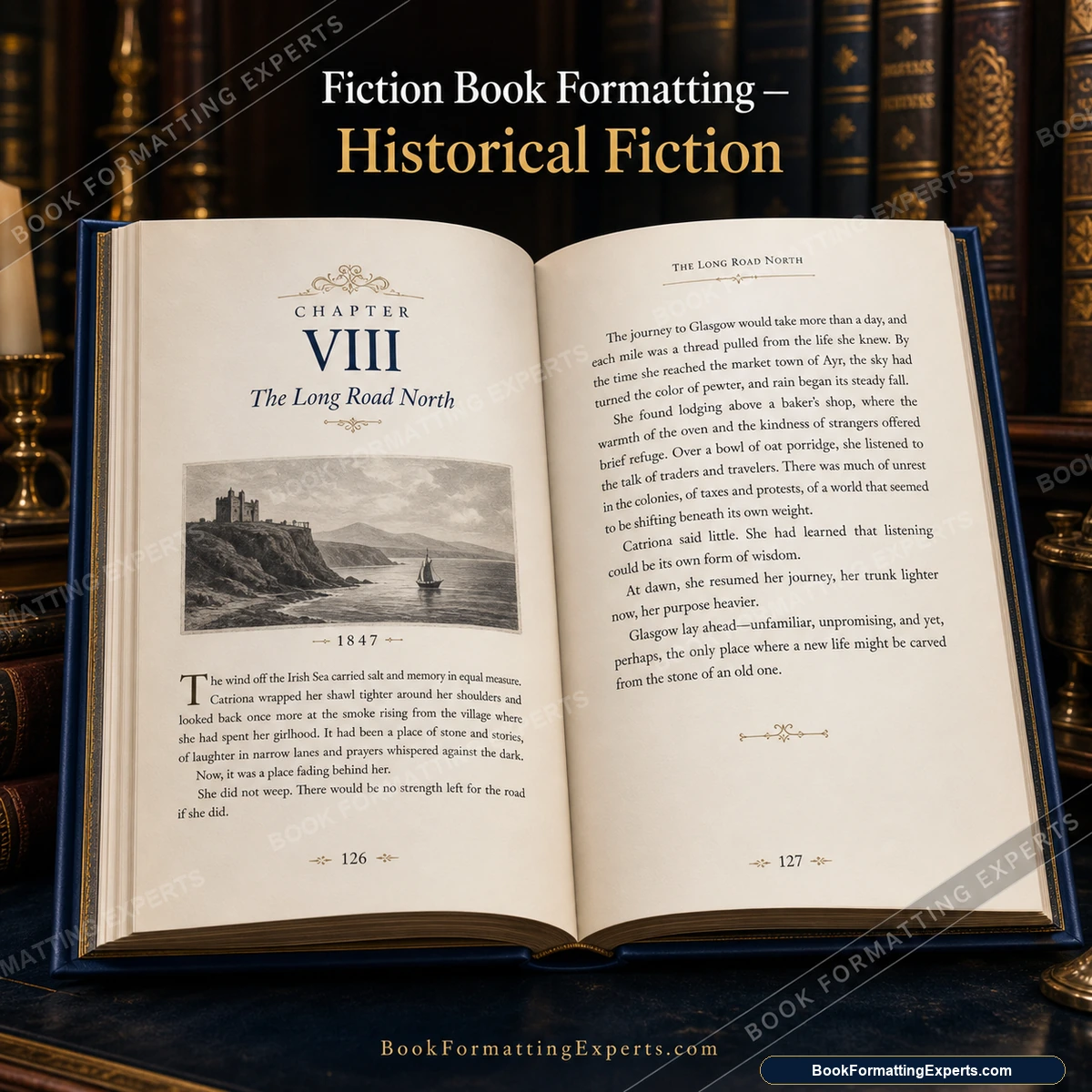
Historical Fiction
A finished Historical Fiction example from our Fiction Book Formatting work.
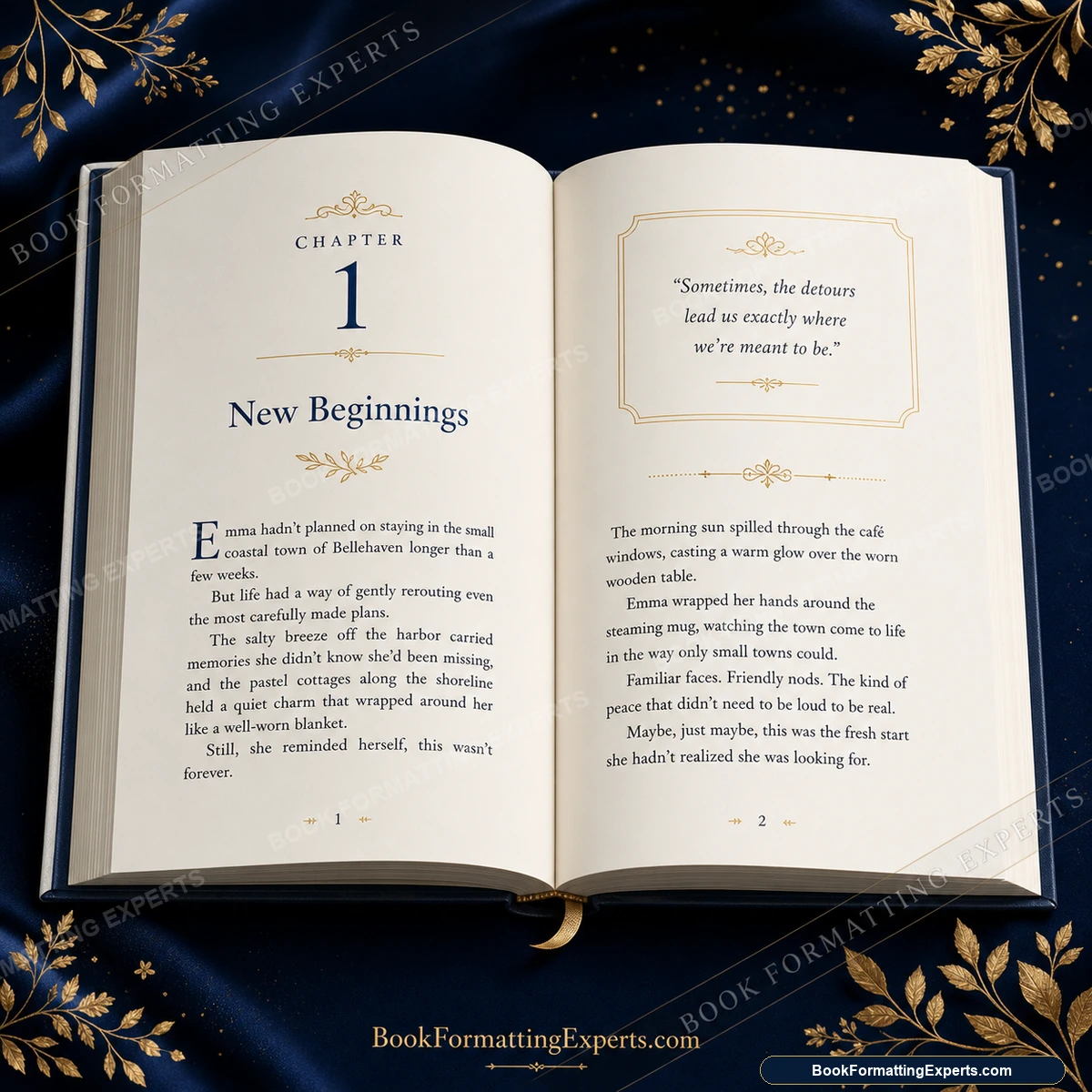
Women's Fiction
A finished Women's Fiction example from our Fiction Book Formatting work.
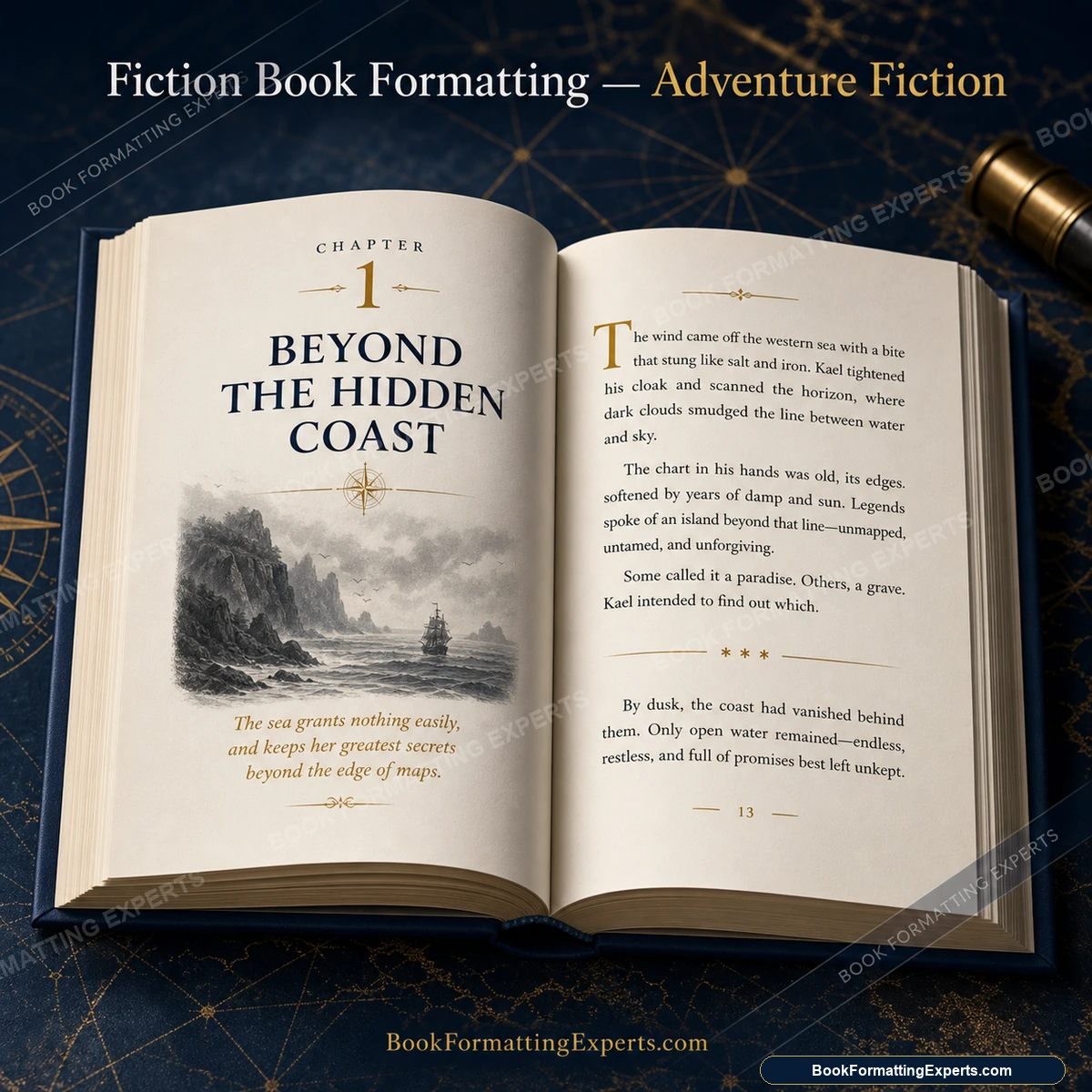
Adventure Fiction
A finished Adventure Fiction example from our Fiction Book Formatting work.
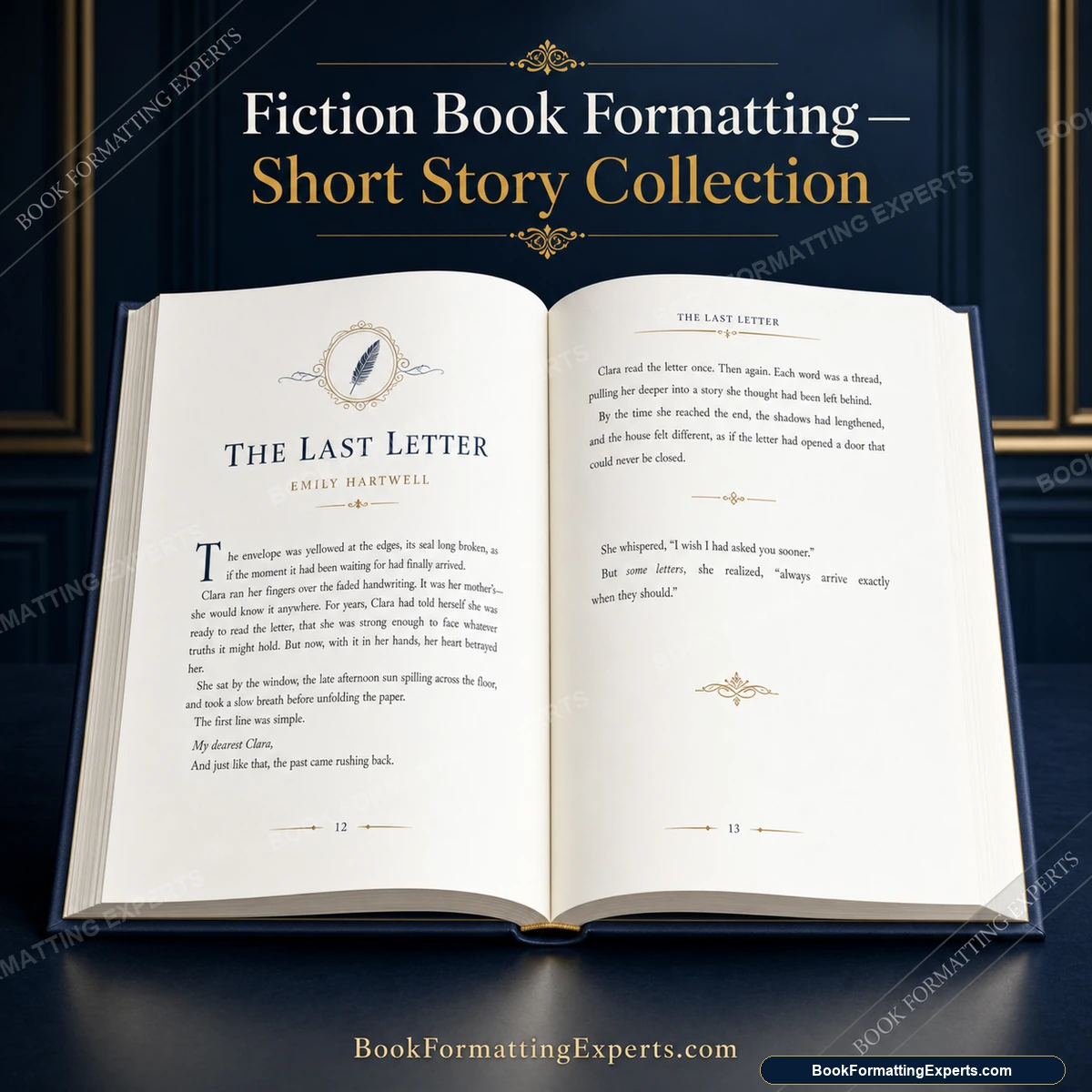
Short Story Collection
A finished Short Story Collection example from our Fiction Book Formatting work.
Our standard
The standard we hold every fiction book formatting to
Consistency in every element
In a novel the same thing must always look the same. We apply one style to every instance of scene breaks, chapter openers and drop caps and ornaments, so the book reads as a single, deliberate design.
Platform-ready from the start
Files are built to current KDP, IngramSpark and ebook retailer rules from the first page, not corrected at the end. Passing the platform check is part of the job, not an extra. You can check it for yourself, because the evidence comes with your files with your fiction book formatting.
Proof read by eye
Software finds many errors but not all. A person reads the proof of every novel, because loose lines, awkward breaks and odd spacing are visible to readers and invisible to a script. Holding to it costs us time, and it saves you the cost of repairs later in this fiction book formatting order.
Checklist
The pre-delivery checklist for a fiction book formatting
Every item below is verified on your fiction book formatting before it leaves our desk.
- Trim size confirmed at 5.5 x 8.5 inches or the agreed alternative
- Margins calculated for the final page count and paper
- Body type set as an 11-point serif such as Garamond or Caslon with comfortable leading
- Heading hierarchy styled and applied throughout
- Scene breaks styled consistently on every occurrence
- Chapter openers checked on every page where they appear
- Front matter complete and in the correct order
- Contents page and page numbers verified against the final layout
- Print PDF preflighted and EPUB tested on current devices
How we think
How we think about your fiction book formatting
Structure is the product
In a novel, scene breaks and chapter openers define the reading experience. We treat structure as the main deliverable and decoration as a finishing touch, because readers return to a book that is easy to use.
Details are the craft
The difference between an adequate interior and a professional one lives in small decisions: a kept-together heading, a balanced spread, a table that splits cleanly. We make those decisions deliberately and document them. It is the principle behind most of what we do on novel, and the reason we prefer to explain our choices rather than hide them.
A layout is a long-term asset
You will probably revise, reprint or extend this novel. We build the layout so that future changes are quick, and we hand over the specification so you are never dependent on us for routine updates.
Client reviews
What novelists say about our fiction book formatting
Verified reviews from fiction authors across romance, fantasy and thriller. Clients rate us 4.9 out of 5 overall, and these six are about novels.
My paranormal romance had an unusual chapter structure with alternating POVs. Every transition was formatted cleanly. The visual rhythm of the page keeps readers moving through the story naturally.
Fantasy books need careful layout to handle maps, epigraphs, and chapter artwork. Every element was handled with real understanding of the genre. The final interior is exactly what a fantasy reader expects.
My world-building sections, map pages, and chapter epigraphs were all handled with genuine understanding of the genre. The interior feels as immersive as the story itself. My readers noticed immediately.
My thriller needed a fast, clean layout with short chapters that kept the pacing tight on the page. The formatting reinforced the reading rhythm I had built into the manuscript. Exactly right.
My psychological thriller had unreliable narrator chapters that needed specific typographic signals to the reader. Every formatting choice reinforced the story. My beta readers said the book felt cinematic.
The atmospheric chapter openings matched the tone of my books without being overdone. The specialist clearly understood what dark fantasy readers expect from a professionally formatted interior.
Poetry formatting requires sensitivity to white space, line breaks, and stanza spacing that most formatters do not understand. Every poem in my collection is laid out exactly as I intended. The visual rhythm is right.
Cookbook formatting is a specialised skill. The recipe layouts, ingredient column alignment, and index were all formatted beautifully. The food photography placement looks professional and the page flow is logical.
Picture book layout is genuinely a specialist skill. The text placement, illustration bleed areas, and page proportions were all handled perfectly. My printer accepted the files on the first submission.
The citation formatting, chapter opening pages, and bibliography were all handled precisely. For a scholarly publication, these details matter enormously. The finished book looks authoritative and professional.
Clean formatting with a professional result. The chapter timeline structure I used was a bit unusual but the formatter handled it well. One revision round to adjust some photo sizing and it was done perfectly.
The Kindle file looks professional on every device I have tested it on. Consistent fonts, clean line spacing, and the table of contents navigates properly. My readers have noticed the improvement over my previous book.
My self-help book needed a layout that felt warm and approachable without losing professionalism. The chapter openings, pull quotes, and action steps all worked visually together. Readers have commented on how easy it is to work through.
Business books need to feel authoritative while remaining readable. The interior design achieved both. The chapter structure is clear and every table reads cleanly. My corporate clients have all commented favourably.
Good quality work. The interior looked professional and the file passed KDP without issues. One revision round was needed for some heading spacing but it was fixed quickly and without any fuss.
Tight, clean, and exactly on brief. The chapter openers had the tension-driven feel the genre demands without being overdone. Upload to KDP was approved without a single correction requested.
Good work overall. The formatting was clean and the file passed KDP first time. I would have liked slightly more communication during the process but the end result was exactly what I needed.
My romance novel needed a warm, readable layout with consistent chapter styling. The specialist understood exactly what I was after and the finished file exceeded my expectations on every page.
FAQ
Fiction formatting questions, answered
These are the questions novelists ask most about fiction formatting, including genres, trim size, scene breaks and cost. If yours is not here, request a quote and a specialist will reply in plain English.
How should I format a novel for print?
Choose a trim such as 5.5 x 8.5, set margins from the page count, use an 11-point serif with comfortable leading, style chapter openers and scene breaks consistently and export a PDF with fonts embedded. For a novel, structure carries the reading experience, so we plan it before we set the first page.
Do you handle fiction novel formatting?
Yes. It is part of our novel formatting work: we plan the layout, style scene breaks, chapter openers and drop caps and ornaments, build print and ebook files and check them against platform previewers. Most readers who want to disappear into a story read on both paper and screens, so we build and test for both.
Do you offer fiction book formatting services?
Yes. Fiction book formatting is the core of this page: we format your novel for print and ebook, handle scene breaks, chapter openers and drop caps and ornaments, and deliver upload-ready files. On this fiction book formatting job, the calculator on this page shows the fixed price for each package before you commit.
Can I hire a fiction book formatter?
Yes. You can hire a fiction book formatter from our team. A specialist who handles novels regularly knows how to deal with scene breaks, chapter openers and drop caps and ornaments, and builds the files to KDP and IngramSpark specifications. If you are unsure which option fits, send a sample chapter and we will advise.
How to format a novel for kindle?
Start with a trim size such as 5.5 x 8.5 inches, set margins from your page count, choose an 11-point serif such as Garamond or Caslon with comfortable leading, style scene breaks, chapter openers and drop caps and ornaments consistently and export to the platform's requirements. For Kindle, build a reflowable EPUB with a linked contents page, real heading styles and images sized for small screens, then check it in Kindle Previewer. Revision rounds are included, so the first proof does not have to be perfect.
How to format a novel for paperback?
Start with a trim size such as 5.5 x 8.5 inches, set margins from your page count, choose an 11-point serif such as Garamond or Caslon with comfortable leading, style scene breaks, chapter openers and drop caps and ornaments consistently and export to the platform's requirements. For paperback, export a PDF with embedded fonts to KDP's trim, bleed and margin rules, with the inside margin increased for your page count. For a novel, structure carries the reading experience, so we plan it before we set the first page.
Do you provide a fiction book formatting template?
For your fiction book formatting, we build a template for your book and, for series, one that later titles can reuse. We do not sell generic templates, because scene breaks, chapter openers and drop caps and ornaments differ from book to book. Most readers who want to disappear into a story read on both paper and screens, so we build and test for both.
What should I know about best trim size for a novel?
It is the most common trade size for novels, feels natural in the hand and prints economically at most page counts. The trim size also changes your page count and printing cost, so we confirm it with a short test layout before setting the whole book. On this fiction book formatting job, the calculator on this page shows the fixed price for each package before you commit.
What should I know about novel 5.5x8.5 trim size?
It is the most common trade size for novels, feels natural in the hand and prints economically at most page counts. The trim size also changes your page count and printing cost, so we confirm it with a short test layout before setting the whole book. If you are unsure which option fits, send a sample chapter and we will advise.
What is the fiction book formatting cost?
The calculator on this page shows a fixed price for each package, based on length, complexity and options. There are no hourly surprises. Revision rounds are included, so the first proof does not have to be perfect.
Do you offer fiction book formatting for kdp?
Yes. We build the paperback or hardcover interior to KDP's trim, bleed and margin rules, and the ebook to KDP's EPUB guidance. For a novel, structure carries the reading experience, so we plan it before we set the first page.
Do you offer fiction book formatting for ingramspark?
Yes. We build to IngramSpark's specifications, including PDF/X settings where needed, and we can set up files for both platforms. Most readers who want to disappear into a story read on both paper and screens, so we build and test for both.
Do you do novel formatting with scene breaks and drop caps?
Yes. Scene breaks and ornaments, dropped-cap chapter openers and running heads and folios are handled in the layout and checked in the proofs. On this fiction book formatting job, the calculator on this page shows the fixed price for each package before you commit.
Do you do novel interior design with chapter ornaments?
Yes. Scene breaks and ornaments, dropped-cap chapter openers and running heads and folios are handled in the layout and checked in the proofs. If you are unsure which option fits, send a sample chapter and we will advise.
Do you offer fiction book epub formatting?
Yes. We build a reflowable or fixed-layout EPUB as the book requires, test it in previewers and check scene breaks, chapter openers and drop caps and ornaments survive on small screens. Revision rounds are included, so the first proof does not have to be perfect.
Do you offer professional fiction book formatting for self-published authors?
Yes. We work with self-published authors every week, and we match the finish of traditionally published novels. For a novel, structure carries the reading experience, so we plan it before we set the first page.
What is fiction book formatting?
It is preparing a novel for print and ebook with a consistent, professional interior. Most readers who want to disappear into a story read on both paper and screens, so we build and test for both.
Is a novel 5.5x8.5 trim size right for me?
A novel 5.5x8.5 trim size is the most common trade paperback format, and it suits most fiction of 60,000 to 120,000 words.
How much does fiction book formatting cost?
Fiction formatting starts at $239 for up to 10,000 words and rises to $889 for 130,001 to 150,000 words, including eBook and paperback. A typical 80,000-word novel is $639.
How long does fiction formatting take?
Standard delivery runs from 3 to 4 working days for a short piece up to 9 to 13 working days for the longest novels. The faster tiers cut the waiting time, and you can watch the estimate change in the calculator.
How much does fiction book formatting cost?
Fiction book formatting starts at $239 for up to 10,000 words and rises to $889 for the 130,001 to 150,000 word band, including an eBook and a paperback. The calculator shows your total.
Ready when you are
Ready for a novel that looks traditionally published?
Your readers should be lost in the story, not distracted by the page. Get your fiction book formatting price in a minute, or send us a larger project and we will quote it with a real date.
- Fixed price shown before you pay
- Revision rounds included
- One named specialist, brief to upload