eBook Formatting Services

EPUB Formatting Built to the Specification, Not to a Guess

EPUB is a standard with a written rulebook, and most files fail it in the same handful of ways. A manifest that lists a resource the package does not hold. A spine in the wrong order. A nav document with no NCX behind it. We format to the specification, validate against EPUBCheck, and hand you the file plus the evidence that it conforms.

Valid EPUB 3, with a package document written by hand and read by a person Nav document plus NCX fallback, landmarks, and a correct page list where needed EPUBCheck clean, with the report delivered alongside the file Reading-system differences documented, not discovered by your readers
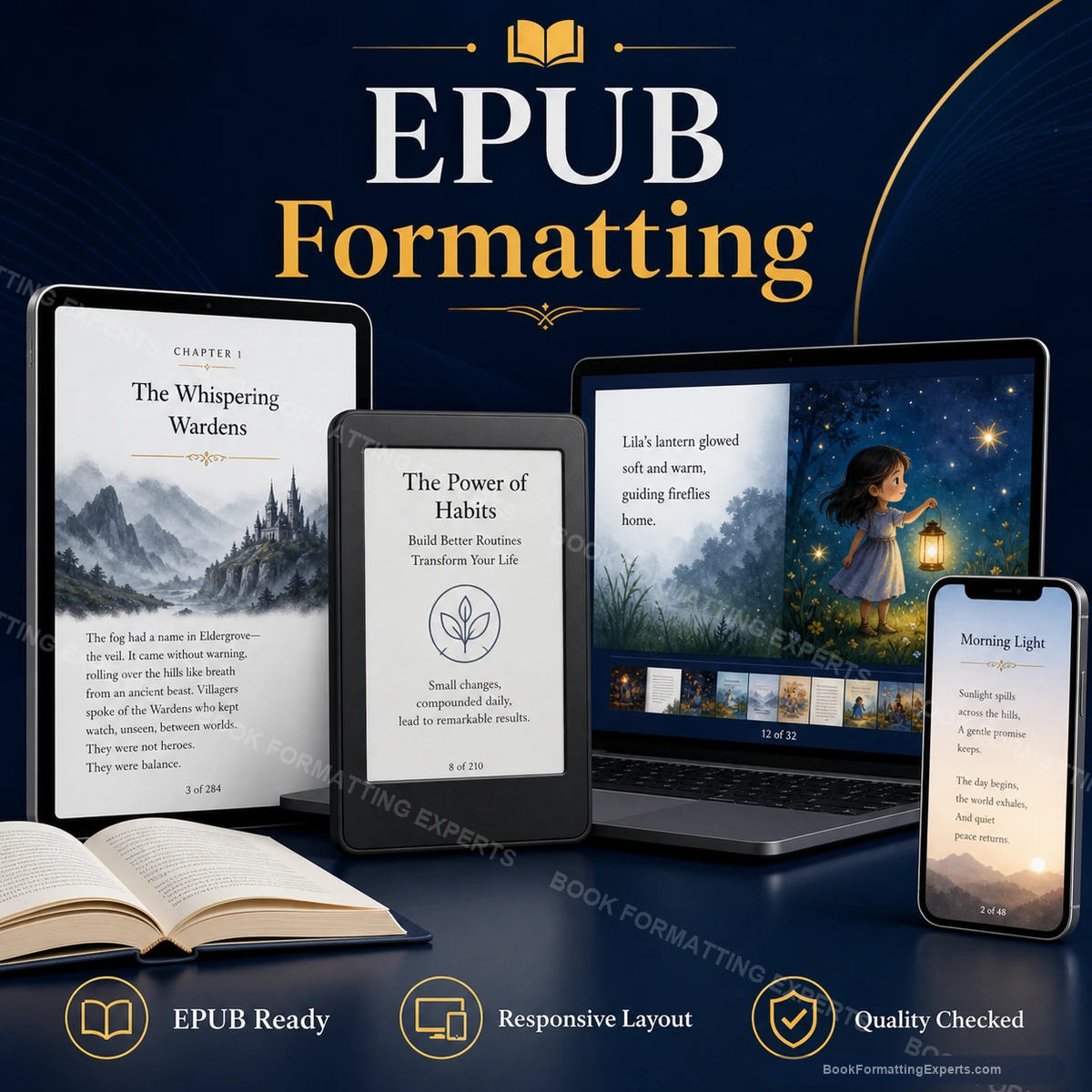
EPUB Formatting sample showing epub formatting hero
211EPUB files formatted
4.9Average client rating
0Errors at EPUBCheck on delivery
14Reading systems in the test matrix
Definition

What EPUB Formatting Means at the Level of the Specification

An EPUB is a ZIP archive with rules. Inside it sit your content documents as XHTML, a stylesheet, your images and fonts, a navigation document, and one file that governs everything: the package document, usually named with an OPF extension. Format the EPUB properly and every part of that archive agrees with every other part. Format it badly and the archive still opens, which is precisely the trap.

The package document carries the metadata, the manifest and the spine. The manifest is the inventory: every resource in the book, declared with its media type. The spine is the reading order: which content documents a reader moves through, and in what sequence. If a file exists in the archive but is missing from the manifest, EPUBCheck fails you. If it is in the manifest but absent from the archive, EPUBCheck fails you harder.

EPUB formatting, done to spec, means the content documents are valid XHTML, the CSS is confined to the properties reading systems actually support, the navigation document lists the real structure, the fonts are legally embeddable and correctly declared, and the metadata says who wrote the book, in what language, under what identifier. That is the whole job, and it is entirely checkable.

Conformance

EPUB 2, EPUB 3 and Why the Difference Still Bites

EPUB 3 replaced XHTML 1.1 with HTML5, replaced the NCX with the navigation document, added media overlays, added proper accessibility metadata and made fixed layout part of the standard rather than a vendor extension. Files written to the older version still exist in enormous numbers, and stores are steadily stopping accepting them.

The practical consequence is that you cannot simply choose one. Modern reading systems want the EPUB 3 nav document. A meaningful number of older Kindles and library platforms still read the NCX. A well-formatted EPUB carries both, which is legal, and which is what we ship.

1

The package document

Metadata, manifest and spine, plus the bindings and fallback declarations. Every rejection we have ever investigated traced back to something written here or missing from it.

2

The navigation document

An XHTML file with a nav element carrying the table of contents, the landmarks and, for print-mapped titles, the page list. It is content and structure at the same time.

3

The NCX fallback

Deprecated in EPUB 3 and still read by hardware in real hands. Including it costs a few kilobytes. Omitting it costs part of your audience their contents list.

What Is Included

What an EPUB Formatting Job Covers

Every layer of the archive, from the container up. Nothing left at its default value because nobody looked.

Package document written by hand

Metadata, manifest and spine authored rather than generated. Every resource declared with the correct media type, every content document placed in the spine in true reading order, and the linear attribute used deliberately so ancillary pages do not interrupt the flow.

Navigation document and NCX

An EPUB 3 nav with a table of contents, a landmarks section identifying cover, start of content and back matter, and where the title maps to a print edition, a page list. An NCX ships alongside it for reading systems that still expect one.

Valid XHTML content documents

Content split into per-chapter documents, each well-formed, each using semantic HTML5 elements and EPUB structural semantics. Well-formedness is not a stylistic preference here, it is a condition of the file being an EPUB at all.

CSS confined to what is actually supported

The stylesheet uses only properties reading systems honour, with declared fallbacks where support is partial. Anything speculative is tested on hardware before it is allowed to stay, and dropped if it fails anywhere it matters.

Fonts embedded and licensed

Typefaces checked for an embedding licence, subset to the glyphs the book uses, declared correctly in the manifest and stylesheet, and obfuscated where the foundry requires it. Fallback stacks sit behind every family.

Validation and conformance evidence

EPUBCheck run against the final package until it reports nothing, plus each retailer's own ingestion validator. The report comes to you with the file, so conformance is something you can see rather than something we assert.

Portfolio

EPUB Files Formatted to Spec

Six recent packages, each one validated, each one shaped by the demands of its content.

Recent Work
Choose your conformance target

Reflowable EPUB 3 or Fixed-Layout EPUB 3

Both are legal EPUB 3. They declare themselves differently in the package metadata, they are validated against different expectations, and retailers treat them as separate products.

Reflowable Conformance

The package declares no fixed layout, no viewport is set, and the reading system is free to repaginate. Content documents flow, CSS is written in relative units, and the reader controls type size, family and margins.

This is the default target and the one nearly every prose title should meet. It is also the only configuration in which accessibility metadata and screen readers work as the specification intends.

Fixed-Layout Conformance

The package carries rendition properties declaring fixed layout, a spread behaviour and an orientation. Every content document sets an explicit viewport in pixels, and elements are positioned absolutely inside it.

Validation is stricter, file sizes are larger, and the reader cannot resize the text. Correct for picture books, comics and heavily designed cookbooks, and wrong for everything else, whatever the designer would prefer.

What We Fix

The EPUB Errors That Get Files Rejected

Six failures, drawn from actual rejection messages. Each one is a class of error, not a one-off accident.

Manifest and archive disagreeA resource is listed in the manifest but absent from the ZIP, or present in the ZIP and undeclared. EPUBCheck raises this as fatal, and every ingestion pipeline refuses the file.
Remote resources referencedAn image or a font pulled from a URL instead of packaged inside the archive. It renders on your machine, where you have a connection, and fails everywhere the book is actually read.
Content documents not well formedAn unclosed tag, a stray ampersand, an attribute without quotes. XHTML is unforgiving in a way HTML is not, and the parser stops rather than guessing.
Missing or wrong media typesA font or an SVG declared with the wrong media type in the manifest. Some reading systems ignore it, some silently fail to load the resource, and validation flags it every time.
Spine order that is not reading orderContent documents listed in the order they were created rather than the order they are read. The book opens, and chapter eleven arrives after chapter two.
No fallback for anything unsupportedUnsupported media, unusual scripting or exotic CSS shipped with nothing behind it. Where the reading system cannot render it, the reader simply gets a blank.
Specification

The Anatomy of a Conformant EPUB File

Eight components inside the archive, what we do with each, and what breaks when it is wrong.

ElementHow we build itWhy it matters
The container fileWritten to declare exactly one root file, pointing at the package document at the correct path.It is the first thing any reading system opens. If it is malformed the book does not exist, and no diagnostic beyond a generic failure is offered.
The package metadataIdentifier, title, language, contributors, modification date and accessibility metadata, all present and correctly typed.A missing language attribute makes hyphenation and text-to-speech behave unpredictably. Missing accessibility metadata now blocks sales to institutional buyers.
The manifestEvery file in the archive declared once, with its media type, and with properties such as nav, cover-image and scripted applied where they belong.Any disagreement between the manifest and the archive is fatal at validation and at ingestion, with no exceptions granted.
The spineContent documents ordered as they are read, with the linear attribute set to no for anything the reader should not fall into unbidden.The spine is the book's reading order. Getting it wrong does not produce an error, it produces a book that reads in the wrong sequence.
The navigation documentXHTML with a nav for the table of contents, a nav for landmarks, and a page list where the title maps to a printed edition.This drives the device menu on every modern reading system. A malformed nav means a reader has no way to reach chapter twenty except by swiping.
The NCXGenerated alongside the nav, listing identical structure, retained for backward compatibility with older hardware.Deprecated is not the same as absent. Library platforms and older e-readers still look for it, and find nothing if it was omitted.
The stylesheetRestricted to supported properties, written in relative units, with vendor differences handled by fallback rather than by hope.Reading systems implement CSS partially and inconsistently. A property that works in Apple Books may be ignored on e-ink, and ignoring it is the good outcome.
Fonts and font declarationsLicence verified, subsetted, declared in the manifest with the right media type, obfuscated where the foundry requires it.An unlicensed embedded font is a legal exposure. An undeclared one is a validation failure. A missing fallback is a book set in a typeface you never chose.
Checked Before Delivery

The Reading Systems Your EPUB Has to Satisfy

Conformance to the specification is necessary and not sufficient. A valid file can still render badly, because reading systems implement the standard partially and differently.

EPUBCheck, first and last

The official validator is run early, so structural problems surface before styling time is spent on them, and again on the final package. Zero errors is the delivery condition, and the report is handed over with the book.

Apple Books

The most faithful CSS implementation among the major reading systems and therefore the best diagnostic environment. If a rule is going to be honoured anywhere it is honoured here, which makes divergence elsewhere easy to isolate.

Kindle Previewer and e-ink hardware

Amazon converts your EPUB into its own internal format at ingestion, and that conversion has opinions. Previewer shows what the conversion did. Physical e-ink shows what it feels like afterwards.

Kobo, Nook and Google Play

Three different engines with three different tolerances. Each is checked for CSS that silently drops, images that scale unexpectedly, and navigation that fails to populate from a nav document it should read.

Screen readers and accessibility tooling

Reading order, heading hierarchy, alt text, language tags and semantic roles are checked with assistive technology, which is what accessibility conformance actually requires and what buyers increasingly audit.

Open-source reference readers

Thorium and other reference implementations follow the specification closely, so they reveal where a file is relying on a vendor's forgiveness rather than on the standard being met.

EPUBCheckAce by DAISYApple BooksKindle PreviewerKoboNookGoogle Play BooksThorium ReaderAdobe Digital Editions
Deliverables

The Package You Receive

The file, its evidence, and everything you would need to hand it to a different specialist tomorrow.

The validated EPUB 3 package

The book itself, conformant, packaged correctly, with the mimetype stored uncompressed as the specification requires and every resource declared. Ready for any store that ingests EPUB, which is all of them.

The EPUBCheck report

The validator's output showing zero errors, together with a note on any warning left in place deliberately and why it is harmless. Some retailers ask to see this. Most of your competitors cannot produce it.

Unpacked source tree

The XHTML documents, the CSS, the package document and the nav, unzipped, commented and readable. This is the difference between owning a file and owning a book you can maintain.

Kindle-compatible derivative

Built from the same validated source and confirmed in Previewer, so you approve Amazon's rendering before publication instead of discovering it afterwards.

Reading-system notes

A short written record of where your file renders differently across systems, what we did about it, and what is simply the nature of the platform. No surprises later.

Metadata sheet

Your identifier, title, language, contributors and accessibility declarations, written out plainly so you can enter them at each store and have them match what is inside the file.

Process

How an EPUB Formatting Job Proceeds

Five stages, run in the order that catches problems while they are still cheap.

01

Specification review

We establish the target: EPUB 3 reflowable or fixed layout, which reading systems must be satisfied, whether a page list is needed, whether accessibility conformance is being claimed formally. These decisions govern everything downstream.

02

Content document build

The manuscript is split into per-chapter XHTML, made well formed, and marked up with semantic HTML5 and EPUB structural semantics. Validation runs here, before anything is styled, so structural errors never get buried under CSS.

03

Package and navigation

The package document is written: metadata, manifest, spine, properties, fallbacks. The nav document and the NCX are generated from the actual structure and then checked against it by a person.

04

Style and reading-system testing

The stylesheet is written against known support, then the file is put through the test matrix. Anything that drops on a given system is either given a fallback or removed.

05

Validate, document, deliver

EPUBCheck to zero errors, ingestion checks at each store, then handover with the report, the source tree, the metadata sheet and the reading-system notes.

Pricing Calculator

EPUB Formatting Pricing Calculator

EPUB work is priced on word count, because length drives the number of content documents, navigation entries and validation passes. The source you send and the structure inside it adjust it from there.

Build Your EPUB Formatting Quote

Required steps are marked with *. Optional extras can be removed from the summary with the cross icon.

Delivery
Total$0
1

Book Type *

Locked

The kind of content being packaged. This determines how much structural markup the content documents need.

Fiction and ProseIncludedStraight narrative content. Simple content documents, a clean spine, and a nav that maps directly to chapters. The baseline EPUB build.
Nonfiction and Reference+$62Deep heading hierarchies, lists, boxed content and sidebars, all needing correct structural semantics rather than presentational markup.
Academic and STEM+$128Footnotes with bidirectional links, tables, figures, MathML and a cross-referenced apparatus. The most demanding conformance work in the EPUB standard.
Fixed-Layout and Illustrated+$144Fixed-layout EPUB 3 with rendition properties, explicit viewports, absolute positioning and optional SVG text. Your size choice sets the image count.
2

Book Size*

Locked

Total word count of the finished text, front and back matter included.

Up to 10,000 words+$161Total word count of the finished text, front and back matter included.
10,001 to 20,000 words+$205Total word count of the finished text, front and back matter included.
20,001 to 35,000 words+$271Total word count of the finished text, front and back matter included.
35,001 to 50,000 words+$345Total word count of the finished text, front and back matter included.
50,001 to 70,000 words+$429Total word count of the finished text, front and back matter included.
70,001 to 90,000 words+$529Total word count of the finished text, front and back matter included.
90,001 to 120,000 words+$645Total word count of the finished text, front and back matter included.
120,001 to 150,000 words+$779Total word count of the finished text, front and back matter included.
More than 150,000 wordsCustom QuoteReference works, multi-volume sets and anything above the top tier are quoted individually. The number of content documents and navigation entries drives the estimate, so send the manuscript.
3

Output Package *

Locked

How much conformance evidence and how many derived files you want alongside the EPUB itself.

EPUB 3 package onlyIncludedThe validated file, nothing else. Right if you already have a pipeline and simply need a conformant package to feed into it.
EPUB 3 plus validation report+$36Adds the EPUBCheck output and the reading-system notes, so the conformance of the file is documented rather than claimed.
EPUB 3 plus Kindle derivative+$58Adds a Kindle-compatible file built from the same validated source and confirmed in Previewer before delivery.
Full specification pack+$114Package, validation report, Kindle derivative, unpacked source tree, metadata sheet and reading-system notes. Everything, labelled and archivable.
4

Interior Complexity *

Locked

The amount of structure inside the content documents. Notes, tables and figures all carry markup and validation cost.

Linear proseIncludedChapters and paragraphs. One content document per chapter, a straightforward spine and a nav that mirrors it exactly.
Structured content+$53Multiple heading levels, lists, blockquotes, sidebars and asides, each carrying correct structural semantics and each tested for CSS support.
Notes, tables and MathML+$121Bidirectional note links, real tables with header associations, figures with captions, and mathematical notation marked up rather than pasted in as pictures.
5

Interior Images *

Locked

How many images sit inside the book. Each one is declared in the manifest, described, and tested for scaling.

No interior imagesIncludedText only. The cover is still declared with the correct manifest property and does not count here.
1 to 15 images+$29Each declared in the manifest, given alt text, exported for high-density screens and checked for scaling behaviour.
16 to 40 images+$69A properly illustrated interior. Figure and caption semantics are applied, and the package size is monitored against delivery thresholds.
41 to 90 images+$133Heavy illustration. Compression is tuned per image, because at this density the archive size becomes a constraint the specification cannot help you with.
More than 90 imagesCustom QuoteHigh image counts change the shape of the package and often the choice between reflowable and fixed layout. Tell us the count and the source resolution and we will quote it properly.
6

Delivery Speed *

Locked

Standard is the pace at which the full test matrix can be run. The faster tiers buy priority, not fewer checks.

StandardIncludedThe normal queue, with the full test matrix run end to end. Nothing is skipped and nothing is rushed.
Priority+$92Roughly a third off the standard window. Your file moves up the queue, and every validation and reading-system check still runs.
Express+$175About half the standard window. Appropriate when a distribution deadline is already fixed and cannot be renegotiated.
Rush+$282The fastest we will work while still running EPUBCheck and the hardware pass. One revision round instead of two.
7

Revision Rounds *

Locked

Two rounds are included. Additional rounds are for books still being corrected while they are being packaged.

2 Revisions IncludedIncludedTwo full rounds after the proof. Conformance corrections are never counted against these, because those are ours to fix.
2 Additional Rounds+$75Four rounds in total. Sensible where a technical reviewer or a rights holder has to approve the packaged file.
5 Additional Rounds+$155Seven rounds in total. For institutional titles and anything going through a formal approval chain.
8

Optional Extras

Locked

Specification work beyond the standard package: overlays, accessibility conformance, page lists and the like.

Page list for print mapping+$48Page-break markers mapped to a printed edition, exposed in the nav document, so citations and library systems can reference real page numbers.
Accessibility metadata pack+$57Full accessibility metadata, summary and feature declarations written into the package, which several institutional and library buyers now require before stocking a title.
Font licence audit+$66Every typeface in the book checked against its licence for embedding rights, with a written finding and a compliant alternative proposed where the answer is no.
Font obfuscation and subsetting+$79Embedded fonts subset to the glyphs actually used and obfuscated to the specification's algorithm where the foundry requires it, then declared correctly in the manifest.
MathML markup+$89Equations marked up as MathML with a rendered image fallback, so the notation is selectable and readable where supported and still visible where it is not.
SVG text in fixed layout+$104Text set as SVG inside a fixed-layout package, which preserves exact letterforms and positioning where the design will not tolerate substitution.
Accessibility conformance report+$117A formal report against the accessibility specification, produced with the DAISY tooling and a manual pass, suitable for submission to institutional buyers.
Scripted content and interactivity+$138Scripted elements declared correctly in the manifest, with fallbacks for the majority of reading systems that will refuse to run them at all.
Legacy EPUB 2 rebuild+$167An existing EPUB 2 package brought up to EPUB 3: nav generated, deprecated markup replaced, metadata modernised, NCX retained behind it.
Media overlays+$225Recorded narration synchronised to the text with SMIL, so supporting reading systems highlight each phrase as it is spoken. Audio supplied by you or sourced separately.
Request Your Custom Quote
You selected a custom or advanced option, so this project is priced individually rather than through checkout. Send us the details and we will scope it properly.

This covers the EPUB package and its conformance. Editing, proofreading, cover artwork, ISBN registration, narration recording and uploading to your retailer accounts sit outside it and are quoted separately if you want them.

Compare

A Validated Package Against an Unvalidated Upload

Two files can look identical in a preview window and behave completely differently the moment a store's ingestion pipeline opens them.

What you are comparingUnvalidated EPUB UploadsBook Formatting Experts
Package document Generated by a tool, never read, with default metadata and a manifest nobody has compared to the archive. Authored by hand, every resource declared, every property applied deliberately, the spine in true reading order.
Validation Run once, if at all, and only after the store has already said no. Run early and again on the final package, to zero errors, with the report delivered to you.
Navigation A nav document alone, so older hardware and library platforms show a book with no contents list. Nav plus NCX plus landmarks, and a page list where the title maps to print.
CSS Written for the previewer on the designer's laptop, using properties half the market ignores. Confined to supported properties, with declared fallbacks, then tested across the reading-system matrix.
Fonts Embedded because they were installed, with no licence checked and no fallback declared. Licence audited, subset, declared, obfuscated where required, and backed by a fallback stack.
A rejection message An error code and a week of guessing which of a hundred things it refers to. It does not arrive. If it somehow does, we read the code, name the cause and reissue.
Who This Is For

Content Types and the Specification Problems They Raise

Every kind of book stresses a different part of the standard.

Fiction

The simplest conformance target and the easiest to get subtly wrong. One content document per chapter, a spine that matches the reading order, and a nav generated from real headings rather than from bold text pretending to be headings.

Nonfiction and business

Deep heading hierarchies, callouts, sidebars and checklists. The specification has structural semantics for all of these, and using them means an assistive reader can distinguish a warning box from a paragraph instead of hearing them as one continuous voice.

Memoir

Photographs, letters and quoted documents, which means figures with captions, correct alt text and language attributes wherever the text switches tongue. The language attribute is the one everybody forgets, and text-to-speech suffers immediately for it.

Educational and academic

The hardest conformance work in EPUB. Bidirectional footnote links, tables with proper header associations, MathML, figure numbering and a cross-reference apparatus that has to resolve correctly on every system in the matrix.

Poetry

Verse needs real line semantics, not paragraphs. Runover lines need hanging indents that survive a change of type size, and stanza spacing has to be styled rather than typed as empty lines, which reading systems collapse without telling you.

Fixed-layout titles

Rendition properties in the package, an explicit viewport in every content document, spread behaviour declared, and often SVG text. Validation is stricter and the tolerances are tighter, and a small error here stops the file dead.

Standards

Conformance Is Not an Opinion

Most arguments about formatting are matters of taste. This one is not. EPUB is a published specification with a reference validator, and a file either conforms to it or does not. That is a rare and useful thing in creative work: an objective standard you can point at.

Which is why we deliver the evidence and not just the file. The EPUBCheck report either says zero errors or it does not. You should not have to take anybody's word for it, including ours.

Three Positions We Hold

1

Validate before you style

Structural errors found after the CSS is written are expensive, because the styling has to be unpicked to reach them. The content documents are made valid first, always.

2

Support is not the same as spec

A property can be perfectly legal and still be ignored on half the devices your readers own. The specification tells you what is allowed. The test matrix tells you what will happen.

3

Deprecated is not dead

The NCX is deprecated in EPUB 3 and it is still read by hardware in people's hands right now. We ship it. The cost is a few kilobytes and the benefit is a working contents list.

Quality Control

The Conformance Checklist

Twelve checks against the specification, run on the final package before anything is delivered.

EPUBCheck reports zero errors against the packaged file
The mimetype file is first in the archive and stored uncompressed
The container declares exactly one root file at the correct path
Every archive resource is declared once in the manifest with the right media type
The spine order matches the intended reading order, with linear set deliberately
The nav document contains a table of contents and a landmarks section
An NCX is present and lists structure identical to the nav document
No resource is referenced from a remote URL
All content documents parse as well-formed XHTML
Every embedded font is licensed, subset and declared in the manifest
Language, identifier, title and contributor metadata are complete and correct
The file has been opened on the full reading-system matrix and behaves in all of it
Before We Start

Who Comes to Us for EPUB Formatting

Six situations where the specification, rather than the design, is the problem.

You have been rejected by a retailer

An error code arrived and it meant nothing to you. Send us the message and the file. The code identifies the class of failure, the file shows the cause, and both are usually fixable within a day rather than a fortnight.

You are a publisher with a house standard

You need every title packaged identically, validated, documented, and accompanied by metadata that matches what you have entered at the stores. Consistency at the package level is what keeps a list from becoming a support burden.

You are technical and you want it done right

You know what an OPF is, you can read a validator report, and you simply do not want to spend three weeks learning the parts of the specification that only matter once. Fair enough. That is what we are for.

You have accessibility obligations

A library, an institution or a jurisdiction requires an accessibility conformance claim. That is metadata, semantics, reading order and a formal report, and it is far cheaper to build in than to retrofit.

You are distributing to libraries

Library platforms are stricter than consumer stores and older in their tooling. They want the NCX, they want the metadata complete, and they will refuse a file the retail shops would have waved through.

You have a technically demanding book

MathML, media overlays, fixed layout with SVG text, scripted content. These sit at the edge of what reading systems support, and they need someone who has already found out where each system stops.

Our Promise

Our Commitments on Conformance

Three, each one testable by you with free software.

Zero errors, verifiable

The file we hand you passes EPUBCheck with no errors. Run it yourself. The report we include should match the report you generate, exactly, and if it does not we want to hear about it immediately.

Rejections are ours to solve

If any retailer refuses a package we built, on any conformance ground, we diagnose it and reissue at no charge. Naming the exact rule you tripped is part of the fix, not an extra.

Nothing is hidden in a warning

Where a warning is left in place deliberately, it is written down with the reason. We do not deliver a file with unexplained validator output and let you discover it later.

Strategy

How We Read the Specification

Three habits that keep files conformant and readable at the same time.

Structure carries the meaning

A visual effect that is not backed by structural markup is invisible to a validator, a search index and a screen reader. If the reader is meant to understand something, the markup has to say it, not merely show it.

Ship the fallback

Every risky property, every unusual media type and every deprecated construct gets something behind it. The reading system you did not test on is always the one your best reviewer uses.

The package is a durable artefact

A conformant, commented, well-structured EPUB can be updated in an hour when a retailer changes a rule. That is the real return on formatting to the specification, and it arrives years after you paid for it.

The Short Version

The Conformance Framework

Three layers of correctness, each one meaningless without the one below it.

1

Well formed

The XHTML parses, the ZIP is packaged correctly, the mimetype is where it belongs. Nothing else can be assessed until this is true, because a file that does not parse is not an EPUB.

2

Valid

The package document agrees with the archive. The manifest, the spine, the metadata and the navigation all describe the same book. This is what EPUBCheck measures, and where most files fail.

3

Supported

The file behaves on real reading systems. Valid and unreadable is a real outcome, and this last layer is the one the specification cannot promise you and the test matrix can.

Client Reviews

What Authors Say After the Files Land

Rated 4.9 out of 5 across 211 reviewed projects.

★★★★★

I had already paid someone else to format this book once. The chapter headings shifted every time a reader changed the font size and I only found out from a review. This team rebuilt the interior from the structure up and sent me photographs from four real devices before I uploaded anything. First launch day I have not spent refreshing the reviews in a panic.

MW
Marianne WhitlockUnited Kingdom Verified
★★★★★

What sold me was the audit. They came back and told me two chapters had been pasted in from another document and were carrying invisible styles, and that fixing that first would save me money later. Nobody had mentioned it in three years of self-publishing. The proof needed no corrections at all.

DA
Devon AchebeUnited States Verified
★★★★★

My book has footnotes, tables and two appendices, and every quote I got either ignored that or doubled the price because of it. Here the pricing was laid out step by step and I could see what each element cost before I committed. It arrived early and the notes link both ways, which nobody else had even offered.

SL
Suvi LehtinenFinland Verified
★★★★★

The proof came back from the printer with the margins exactly where they should be, the running heads correct, and not one chapter opening on a left-hand page. This is my fourth book and the first time I have not had to pay for a second proof copy.

RO
Rachel OkonjoCanada Verified
★★★★★

English is my second language and I was nervous about the back and forth. Everything was explained plainly, and when I asked the same question twice they answered as if it were the first time. The revisions were turned round inside two days and I was never made to feel like a nuisance.

TI
Tomas IglesiasSpain Verified
★★★★★

I write cookbooks, so the interior is the product. Ingredients have to sit beside the method or the recipe stops working, and the last person I hired reflowed the whole thing into nonsense. These people understood the problem before I had finished describing it and the finished layout is genuinely beautiful.

PR
Priya RaghunathanIndia Verified
★★★★★

Straightforward from beginning to end. A fixed price, a delivery window they actually hit, and files that went up to KDP and IngramSpark without a single rejection. I have since sent them two more titles and recommended them to my writing group without hesitation.

GN
Gregory NkemeluNigeria Verified
★★★★★

My memoir has photographs and I had resigned myself to them looking muddy. They optimised every image, told me honestly which two were too low-resolution to save, and suggested crops instead of shrugging. That candour is worth more to me than the discount I was chasing elsewhere.

HS
Hannah SorensenDenmark Verified
★★★★★

I sent them a 480-page reference book with a nightmare of cross-references and a table on nearly every spread. They quoted it accurately, they did not come back later asking for more money, and the index still works. Any author will tell you what that is worth.

EB
Elliot BarrowAustralia Verified
FAQ

EPUB Formatting Services — Your Questions, Answered Properly

The questions authors actually ask us, answered without sales language.

What is EPUB formatting, and how does EPUB 3 differ from EPUB 2?

EPUB formatting is the construction of a conformant EPUB package: valid XHTML content documents, a package document holding metadata, manifest and spine, a navigation document, supported CSS and correctly declared resources. EPUB 3 replaced XHTML 1.1 with HTML5, replaced the NCX with the navigation document, added media overlays and proper accessibility metadata, and brought fixed layout into the standard. EPUB 2 files still exist in huge numbers and stores are progressively refusing them, which is why so much of our work is bringing old packages up to the current specification.

What is inside the package document, and why does it matter?

The package document, usually an OPF file, is the governing file of the whole archive. It holds the metadata, the manifest and the spine. The metadata says who wrote the book, in what language, and under what unique identifier. The manifest lists every single resource in the package with its media type. The spine sets the reading order. Almost every retailer rejection we have investigated came back to something declared wrongly here, or something in the archive that was never declared at all.

What is the difference between the spine and the manifest?

The manifest is the inventory and the spine is the itinerary. The manifest declares every resource the package contains, including images, fonts, the stylesheet and the navigation document, each with its media type. The spine lists only the content documents, in the order a reader moves through them. A file can be in the manifest without being in the spine, which is correct for an image. A file in the spine that is missing from the manifest is a fatal validation error.

Do I still need an NCX file, or is the nav document enough?

Strictly, the navigation document is enough for EPUB 3 conformance and the NCX is deprecated. Practically, you should ship both. Older Kindle hardware and a number of library distribution platforms still look for the NCX, and when they do not find one the reader gets a book with no contents list and no explanation. Including it adds a few kilobytes to the archive. Omitting it silently disadvantages a real slice of your readership, so we generate both from the same structure.

Which EPUBCheck errors are fatal, and which are just warnings?

Fatal errors stop the file being a valid EPUB and every ingestion pipeline will refuse it: a manifest that disagrees with the archive, content documents that are not well formed, a missing or malformed container, a remote resource where none is permitted. Warnings are advisory and some are safe to leave, such as certain notices about deprecated but functional constructs. The dishonest move is to ship warnings without reading them. We deliver at zero errors and we explain in writing any warning we have chosen to leave in place.

Why does my EPUB look different in Apple Books than in Kindle Previewer?

Because they are different rendering engines with different levels of CSS support, and because Amazon converts your EPUB into its own internal format at ingestion rather than displaying it directly. Apple Books honours your stylesheet closely. Amazon's conversion discards or reinterprets a good deal of it, particularly around fonts, margins and anything involving precise positioning. This is not a fault in your file. It is the market, and the answer is to write CSS that degrades gracefully rather than CSS that only works in one place.

Which CSS properties are safe to use across reading systems?

The reliable core is smaller than most designers expect: relative font sizing, line height, margins and padding in em units, text alignment, text indent, basic font family with a fallback stack, page-break-before and after, and simple percentage widths on images. Beyond that, support fragments quickly. Multi-column layouts, advanced selectors, custom properties, floats around images and anything involving precise positioning behave differently on every engine. We use what is supported, declare fallbacks for what is not, and test the result rather than assuming.

Can I embed commercial fonts in an EPUB, and what does the licence have to say?

You can only embed a font whose licence explicitly permits embedding in an electronic publication. Many desktop licences do not, and a print licence almost never does. Shipping a font without that permission exposes you to a takedown or worse. We audit each typeface, and where the licence allows it we subset the font to the glyphs your book actually uses, declare it in the manifest, and obfuscate it where the foundry requires that. Where it does not allow it, we propose a face that does and looks close.

What are media overlays, and do I need them?

Media overlays are a part of the EPUB 3 specification that synchronises recorded narration to the text using SMIL, so a supporting reading system highlights each phrase as it is spoken. They are genuinely useful for children's books, language learning and accessibility, and they are supported by a minority of reading systems. If your audience is on Apple Books or on an accessibility platform, they are worth building. If you are chiefly selling prose fiction on Amazon, they will be quietly ignored and the file will simply be larger.

Why was my EPUB rejected by the retailer, and can you tell me exactly which rule it broke?

Usually yes, and often within a few hours. Forward the retailer's rejection notice along with the file itself. Retailer error codes are terse but they identify a class of failure, and the file then tells us which specific instance of it you hit. The recurring causes are a manifest that does not match the archive, remote resources referenced from inside the package, content documents that fail to parse, a missing or wrong media type, and legacy markup that the store stopped accepting. All of them are fixable.

What is the difference between a reflowable and a fixed-layout EPUB in the package metadata?

It is declared explicitly. A fixed-layout package carries rendition properties in the metadata stating that the layout is pre-paginated, along with the spread behaviour and orientation. Each content document then sets an explicit viewport in pixels, and elements are positioned inside that canvas. A reflowable package declares none of this and leaves the reading system free to repaginate. Retailers treat the two as separate products with separate validation expectations, so getting the declaration wrong is not a cosmetic error.

How do accessibility metadata and semantic tags affect my EPUB?

They decide whether a screen reader can navigate the book and whether an institution is allowed to buy it. Accessibility metadata declares what features the file has: a described reading order, alt text, structural navigation, no known hazards. The semantics decide whether a note is announced as a note and a heading is announced as a heading. Libraries, universities and buyers in several jurisdictions now check this before purchasing, and retrofitting it into a finished package costs several times what building it in would have.

Does my EPUB need a cover image inside it, or does the store use its own?

Both, and they must agree. The store displays the cover you upload separately to its catalogue, and the EPUB must also contain a cover image declared in the manifest with the cover-image property. That internal cover is what the reader sees inside their library and on the first screen of the book. Files that omit it show a blank placeholder in the reader's own shelf, which looks like an error to the person who has just paid for the book.

What is the OPF, and can I edit it myself?

The OPF is the package document, and yes, you can edit it, which is exactly why we ship you the unpacked source. It is an XML file and it is readable. Change the title, add a contributor, correct the language attribute. What you must not do is edit it, rezip the archive carelessly and skip revalidation, because the mimetype file has to be stored first and uncompressed, and a naive zip will break that and produce a file no reading system will open.

How do you handle MathML and technical notation in EPUB 3?

MathML is part of the EPUB 3 specification and support across reading systems is uneven. We mark equations up as MathML, so the notation is real, selectable and readable by assistive technology, and we supply a rendered image fallback for the systems that will not display it. The alternative that many people choose, pasting equations in as pictures, produces something that looks acceptable and is unsearchable, unscalable, invisible to a screen reader and unreadable at a large type size.

Do you support EPUB fixed layout with SVG text?

Yes. Setting text as SVG inside a fixed-layout package preserves the exact letterforms and their exact positions, which matters when the design will not tolerate any substitution or reflow. The cost is that SVG text is not always selectable or searchable, and support for it varies. We use it where the design genuinely demands it, usually in picture books and comics, and we advise against it where ordinary embedded text in a fixed viewport would have done the same job more accessibly.

What identifier should my EPUB carry, and does it need an ISBN?

The package must carry a unique identifier in the metadata. An ISBN is the usual choice and it is what retailers and libraries expect, but the specification only requires uniqueness, so a UUID is valid where you have no ISBN. What matters most is that the identifier inside the file matches the one you enter at the store. A mismatch causes the sort of ingestion problem that is very hard to diagnose from the error message the store sends back.

Why does EPUBCheck complain about my remote resources?

Because an EPUB is meant to be self-contained. A book that fetches its images or fonts from a URL will render on the machine that built it, where the network is available, and then fail for a reader on a plane, on an e-ink device with the radio off, or after the hosting server is retired. The specification permits remote resources only in narrow circumstances. In practice we package everything the book needs inside the archive, which is the only way the file is durable.

How do you test an EPUB before it goes to a retailer?

Validation first with EPUBCheck, run early against the content documents and again on the final package. Accessibility tooling next, to check reading order, headings, alt text and language. Then the reading-system matrix: Apple Books, Kindle Previewer and physical e-ink, Kobo, Nook, Google Play, Adobe Digital Editions and a reference reader that follows the standard closely. The last of those is the important one, because it shows where a file has been relying on one vendor's forgiveness rather than on actually meeting the specification.

Can you deliver a Kindle file from the same EPUB source?

Yes, and it is built from the validated EPUB rather than converted sideways from anything else. Amazon accepts EPUB directly at upload and performs its own conversion at ingestion, so the derived file we produce and check in Previewer is really a preview of what that conversion will do to your book. Seeing it before you publish means you can adjust the stylesheet where Amazon has reinterpreted something, instead of finding out from the first reader who mentions it in a review.
Next Step

Send Us the File and the Error Code

Whether you have a manuscript to package or a rejection message you cannot decode, we will look at it, name what is wrong at the level of the specification, and quote a fixed price to make it conform.

$00 items selected
No options selected yet.
Get a Quote